 OLD TESTAMENT: Genesis 45: 1-15
To read the Old Testament Lectionary passage, click here
This is sort of a climactic point in the relationship of Joseph and his brothers. Joseph sits in a position to do with his brothers as he pleases. Yet he makes no effort to hold their feet to the fire; there is no evidence of anger or irritation. This passage contains high drama. It is a part of the continuing saga of Joseph, who was sold into slavery by his brothers over jealousy and hatred. He is taken into slavery in Egypt, where he rises to the highest of places in the Egyptian government because he provides a service to Pharaoh. So Joseph is chosen as prime minister in charge of both the palace and the country, second only in command to Pharaoh. This comes about 13 years after his enslavement.
Joseph and his wife have two sons—Ephraim (“Prospered”) and Manasseh (“Preserved”), named in recognition of God’s involvement. When the years of famine come, Egypt, like the surrounding nations, is affected but they are the only ones that have stores of grain. Joseph’s wisdom enables Egypt to become the “bread basket for the world.”
The chapter that we read this week is sort of the climax to the story. Standing alone with his brothers, he reveals his identity. (It is interesting that Joseph sort of dismissed everyone. It was as if this was a private family affair. Perhaps he did not want to see his brothers embarrassed. Perhaps he knew he could not contain his own emotions.) All of the brothers are alive. The silence that ensues is the point at which reconciliation is questionable. He asks them to come closer to him, implying that it was alright for them to cross the official barrier. He does not scold them or blame them and doesn’t make them feel guilty. In essence, Joseph has picked up on the theme of “preserving life”.
His conclusion is that in spite of their past history, all will be well because what has happened corresponds to God’s purposes. He invites them to view the past in a positive manner. He instructs his brothers to return to Canaan and bring their father and their families back to Egypt, with the assurance that they will have no worries about possessions. (Historically, pharaohs were generous to Semitic peoples in time of famine.)
Now, thinking back, the reading demonstrates the fulfillment of Joseph’s earlier dreams and the salvific role played by God and Joseph. I don’t really think that God planned for the brothers to do evil and get rid of Joseph. They are fully accountable. But God, in God’s sovereignty and providence, is able to use the situation to bring life and reconciliation into this family of Jacob. God, in typical God-fashion, has done yet another reversal of human plans and human circumstance. It could be said that this passage describes a moment of self-revelation (for both Joseph as well as his brothers). This passage brings us to understand our own soul, our own humanity. It brings about a moment of truth. Twenty-two years after Joseph’s enslavement, it is now a time of reconciliation. It is a story of forgiveness. Perhaps it is also a story of one who sees that things are different now—that the context and the surroundings are different. There is no use carrying grudges or expecting some sort of recompense for what went on before. It is time to move on.
And even beyond that, Joseph has married an Egyptian. He has taken an Egyptian name (Zaphenath-paneah). His children, representing two of the Tribes of Israel, are half Egyptian. No longer is this a story centered only on a family. This culture and this religion has been bridged into another. Joseph didn’t plan to be a bridge. He probably didn’t see it coming at all. But somewhere along the way, the context has changed. And so has Joseph. I do not think that God has made all of this horrible stuff happen to get Joseph to this place. I’m not a big proponent of a micro-managing God that has some unchangeable plan through which we are forced to walk. After all, what happened to that free will thing? God just walked him through it to the other side. And Joseph is different simply because of the journey.
Walter Brueggemann writes that “Joseph, man of faith, takes a second hard look at his life. He is willing to host the hidden, inscrutable, unresolved purpose of God for his life that is beyond his control….he is willing to trust a purpose for his life that is larger than his own horizon” (“Taking a Second, Painful Look” in The Threat of Life: Sermons on Pain, Power, and Weakness). Maybe that’s the whole point. We know that God is bigger than we often view God to be; maybe our life is the same way.
Personally, my first thought would have been to ask God, “Wasn’t there an easier way?” Couldn’t we have just postponed the famine? Or, have Joseph send his resume to Pharaoh after he had his troubling dreams? Did it really take all of that?
Any yet, what the story of Joseph exemplifies is the notion that God does not promise to take away all possibility of pain and discomfort–but rather God promises to be with us through it all. God promises to make great things happen, but not all great things come easily.
Some great things come in a manger. Some great things happen after hasty trips to Egypt. Some terribly wonderful things happen on an old rugged cross.
Our culture always seems to highlight the quick, the easy, the painless. Just pop this pill. Just exercise 10 minutes a day. Just eat grapefruit–lots of grapefruit. Just go to this particular school. Just apply on this website. Just like us on Facebook. But, the biblical view of life is that God doesn’t always look for the path of least resistance. Sometimes God asks us to walk through fiery furnaces or bear a cross. But, on the other side of the valley of the shadow of death we are always presented with the reality that God had never left us. And life is now able to bloom, in the most beautiful and holiest of ways. (From “When God Sends You”, a blog by Rick Morley available at http://www.rickmorley.com/archives/693, accessed 8 August, 2011.)
- What is your response to this passage?
- What is inherent in Joseph’s understanding of God?
- Where do you find yourself in this story?
- What can this say to our world today?
NEW TESTAMENT: Romans 11: 1-2a, 29-32
To read the Lectionary Epistle Passage, click here
This is the third time that we deal with Paul’s struggle over whether or not the Gospel betrays his Jewish heritage and his Jewish nation. Paul is quick to dispute the idea that the Jewish people, God’s Chosen, have just been abandoned. There still remains a remnant of those people. But then what is unsettling to Paul is the possibility that the rest of us might be abandoned. But this leads him to the idea of the “grafting on” of those “non-Jewish” persons. It is a remnant that rather than being “chosen by birth” are “chosen by grace.”
What drives the whole thing is not that Paul needs to show a God who is in control but, rather, one who is compassionate toward all of God’s children. So, essentially, Paul is warning the Gentile followers to not be so arrogant about their beliefs. Israel’s present failure to respond to God does not seal their fate because it is God who deals in compassion. Very cool…an image of a God of compassion rather than a God of rules. When are we going to really get that?
Our Christian proclamation has always included the notion of God’s judgment. Do you think that God is really putting us into piles of “the saved” and “the damned” even as we speak? And, pray tell, how comfortable are we REALLY with that picture? What happened to compassion? What happened to grace? Maybe God is judging us all and saving us all. Is that so hard to fathom, that this God of all Creation, all grace, all beauty might have a plan for us all? Some would claim that to be a sort of “universal salvation”. I don’t think of it like that, necessarily. Somewhere along the way all of us are somehow compelled to move toward God, to respond to God’s calling and God’s love and grace. But if we are proclaiming that this is the God of all and for all, who are we to start siphoning people out into the “damned” pile? Are you really that sure of your own belief to start going there? Are you really that sure what pile you’d be in? Bonhoeffer was right: Grace is not cheap. But it’s free. Free for the taking.
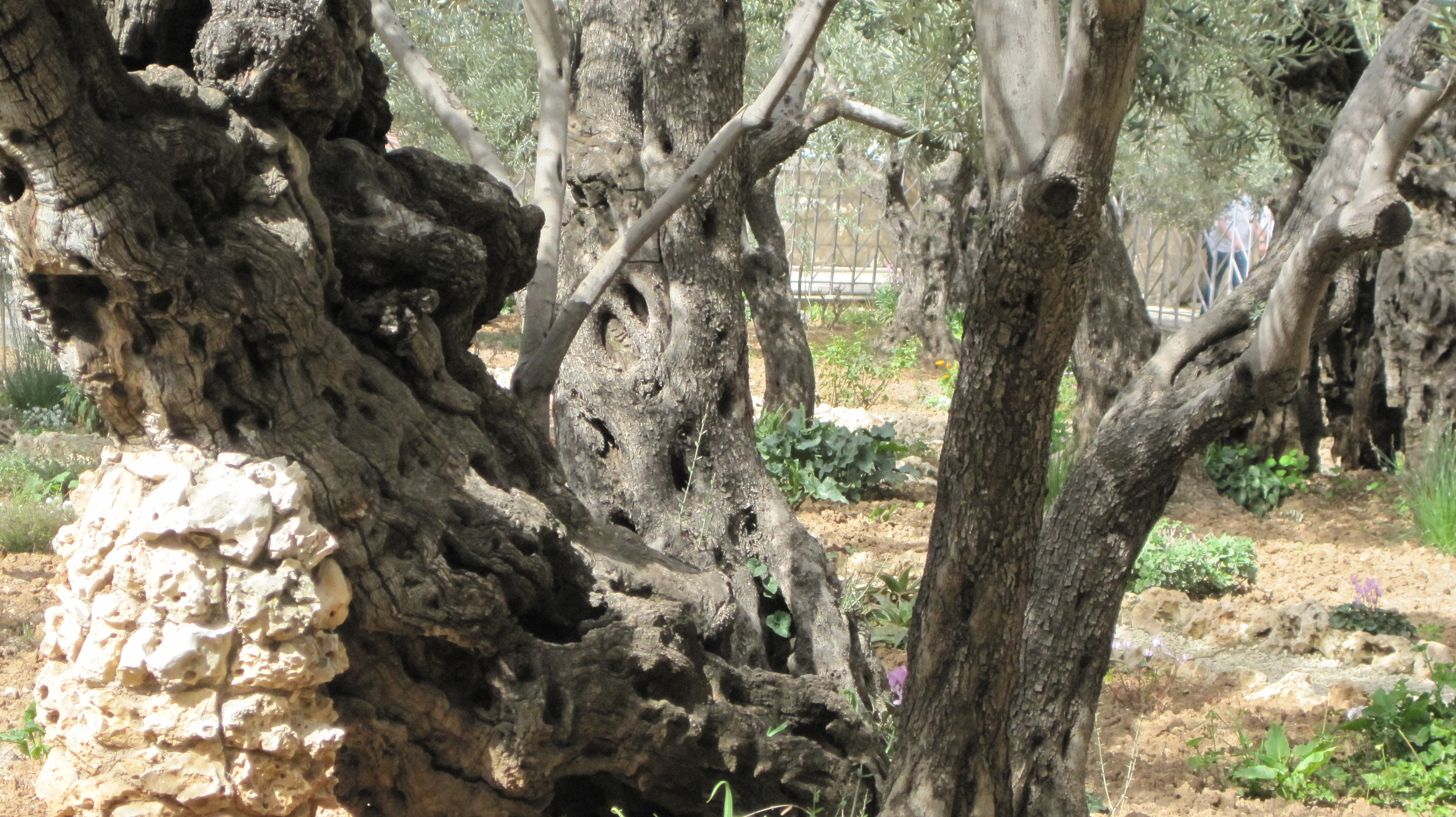
In the Garden of Gethsemene, there is an orchard of olive trees. Olive trees are fascinating. They can live for as long as 900 years. But when they die, they do not just rot away. Their roots give way to new growth, to new shoots. So, even though the tree has died, it lives on in a new tree. Here’s one that I took a picture of last year. The oldest tree is on the bottom left. It’s at least 2,000 years old (which means it was alive that night when Jesus came here with the disciples!). The trunk that is leaning against it is probably about 900 years old. The trunk springing from that is probably 200 years old. And the young tree on the right is probably just a few years old. It is the new shoot. But it does not exist alone. It is growing from the roots of centuries of growth. What a great image! New shoots, new thoughts, new ideas do not replace the old. They grow from it.
Maybe I’m wrong, but at least you can say I erred on the side of grace.
- What meaning does this passage hold for you?
- What does “chosen by grace” mean for you personally?
- Why is it so difficult for most people to exist with those who believe differently? Why do so many of us have to be right?
GOSPEL: Matthew 15: (10-20), 21-28
To read the Lectionary Gospel Passage, click here
In the previous verses, Jesus has had to spend time arguing with the church leaders over what is appropriate behavior for those that are religious. This has gone on and on (and on) and he has even had to tell parables and then re-explain them with little or no success. These people just don’t get it. So he leaves that place.
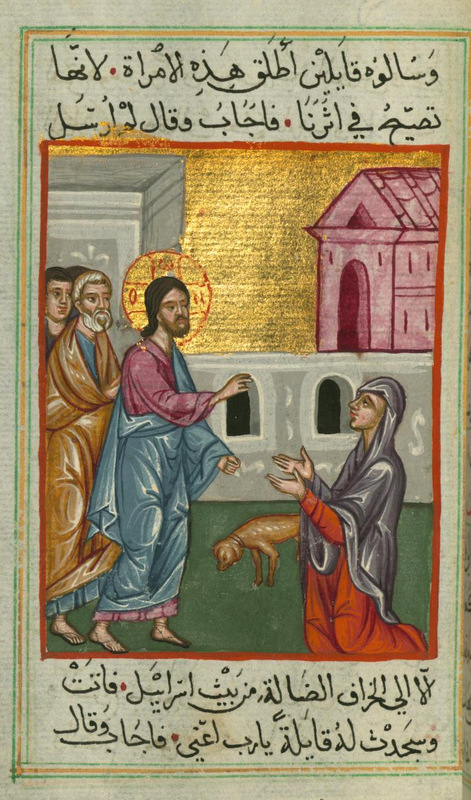
He leaves and travels to a place that is near the border of what is actually Gentile territory. So, first he spends all this time arguing and then he has to travel some distance to an unfamiliar place. In Jesus’ defense, he has to be tired. He has to be craving some time alone to regroup and reflect on his mission. Then, all of a sudden, this woman comes up and she’s shouting at him with some foreign accent—not just a loud shout but one that is incessant and wailing and very annoying. She is begging him to heal her daughter. But what could Jesus really do? After all, his mission as he understood it was at that time to the Jews and here was this Gentile (and a Canaanite to boot) wanting Jesus’ time.
In the Old Testament, there were stories about the “evil” religion of the Canaanites who occupied the Promised Land—a religion of false idols, child sacrifices, and intermarriage. The writer we know as Matthew underscores this. From this point of view, the woman was “scum.” If anyone was the wrong religion, if anyone wasn’t saved, if anyone was damned, she was. In fact, this woman had everything working against her—gender, race, religion, class, and nationalism. In the first century, she was the “outcast of the outcasts”.
Put yourself in Jesus’ place. “Perhaps if I ignore her, she will go away.” But, then, the disciples get involved. “Good grief,” he probably thought, “if they would only be quiet.” And the woman keeps on—shouting and wailing like some sort of banshee. What do you do with a pushy Canaanite woman who won’t shut up? “Don’t you understand…I am not here for you…I must first attend to the Jews…the chosen ones…the children of God…the people to which I was promised…it would not be right to abandon their mission for another.” (I will tell you, the reference to “dogs” is not a nice one. Without offense to the dog-lovers among us, in Jewish society, dogs were looked upon as unclean, as scavengers. To compare someone to a dog was to lower them to the bottom of society.)
But the woman responds, “Yes, Lord, yet even the dogs eat the crumbs that fall from the masters table…Even I, the Gentile, knows that you are Lord.” All of a sudden Jesus’ tune changes. This woman has a faith that will not quit. This woman DOES get it! The mission is indeed to the Jews. But this woman’s faith has brought her to Jesus as a sign of what is to come. This moment is, in effect, a sort of turning point for Jesus’ whole mission. In fact, at the risk of overstepping, you could almost say this was a sort of “conversion point” for Jesus. You also have to consider that this turning point is the reason we’re sitting here. We are not the “children of Israel” but rather those to whom Jesus’ mission was broadened to include.
I think we should be grateful that the writer of Matthew didn’t clean up the story. After all, perhaps it doesn’t reflect well on the Son of God. And yet, there is a powerful statement regarding Jesus’ humanness here, his searching, his exploring, and his changing. In this moment, Jesus saw a broader vision of God than even he had had before. And if you’re uncomfortable with the whole idea of Jesus getting something wrong, try this: What if this whole thing was a test, giving voice to what Jesus may have considered an archaic closed-minded theology? What if the disciples had failed the test? And what would our score have been?
Jesus was converted that day to a larger vision of the commonwealth of God. Jesus saw and heard a fuller revelation of God in the voice and in the face of the Canaanite woman. The woman’s truth is evident in the way Matthew tells this story. At the end of this chapter there is another feeding story. This time 4000 men are fed — besides women and children — and there were seven baskets left over. Seven is the number of wholeness, completeness, a number encompassing the nations. Matthew has placed the story of Jesus and the Canaanite woman between these two feeding stories. The Canaanite woman taught Jesus that she and her daughter deserve more than crumbs. After this encounter Jesus went on to feed those who had not yet been fed.
If Jesus could be changed, can we? Every generation sees some people as “other” and puts them under the table. We could make a long list of people we see as different – different race, different customs, different religion. Two summers ago at one of the raucous town meetings, a white woman who looked a bit like me spoke through her tears, “What happened to my America? I want my America back.” I guess she meant an America where people look like her and me. Over the past ten years, many in the United States have come to see Muslims as the other. They are the Canaanites – not only in this country but in Europe and Scandinavia. In protests against a proposed Muslim Cultural Center in lower Manhattan, people carried signs that read: “All I need to know about Islam I learned on 9/11.” Really? What if someone protested outside the church I attend with a sign saying: “All I need to know about Christianity I learned from Rev. Terry Jones.” Muslims have become Canaanites to many in our country. One candidate in the presidential primary race has called for a ban on building mosques in the U.S. Three states have enacted statutes against Shariah, though there is no evidence that Muslims have proposed Islamic law for this nation. (Andrea Elliott, New York Times, July 30, 2011)
This week I went to get coffee at the deli across the street from Union seminary. “I’m a little dizzy,” said the kind man who always works in the afternoon. “You know it’s Ramadan,” he said, “and I haven’t eaten all day.” I realized that I had never asked him his name. Perhaps we will behave like the disciples: “Send the Muslims away for they are ruining our country!” Or maybe we will be as willing to learn as Jesus was. Maybe in this month of Ramadan we will catch a larger vision of the commonwealth of God. (From “Teaching Jesus”, by Barbara Lundblad, available at http://odysseynetworks.org/on-scripture-matthew-15-21-28, accessed 8 August, 2012)
- What meaning does this passage hold for you?
- How would our society and our church fare on that issue?
- What does the fact that the woman “fired back” at Jesus say about her faith?
- What is so difficult about this passage for us?
Some Quotes for Further Reflection:
Remind me that I don’t need to carry the heavy burden of defending You, or religion, or tradition. The best witness I can make is to communicate the joy of knowing You uplifting, carrying power. Keep me from being a person with a heavy attitude others feel must be carried or dragged along. When I allow You to meet my deepest needs, I don’t have to transfer to others the responsibility of making me happy. You do that so well with Your faithful supply of love and encouragement. (Lloyd John Ogilvie)
Every way of seeing is a way of not seeing. (Alfred North Whitehead)
The real voyage of discovery consists not in seeking new landscapes, but in having new eyes. (Marcel Proust)
Closing
For the healing of the nations, Lord we pray with one accord; for a just and equal sharing of the things that earth affords; to a life of love in action help us rise and pledge our word.
Lead us forward into freedom; from despair your world release, that, redeemed from war and hatred, all may come and go in peace. Show us how through care and goodness fear will die and hope increase.
All that kills abundant living let it from the earth be banned; pride of status, race, or schooling, dogmas that obscure your plan. In our common quest for justice may we hallow life’s brief span.
You, Creator God, have written your great name on human kind; for our growing in your likeness bring the life of Christ to mind, that by our response and service earth its destiny may find. Amen. (“For the Healing of the Nations”, words by Fred Kaan, UMH # 428)

 JOURNEY TO PENUEL: Wrestling to See the Face of God