Easter 5B: Unless Someone Guides Me

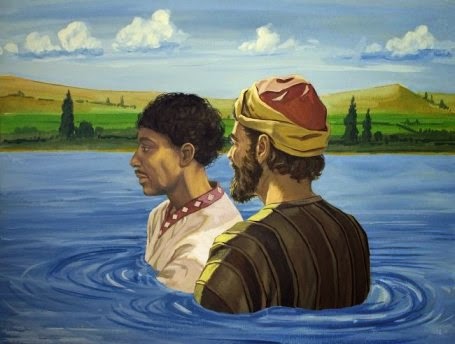
philip_ethiopian2FIRST READING: Acts 8: 26-40

To read the Lectionary passage from Acts, click here

In this part of Acts, the author tells of the spread of good news to non-Jews in the Middle East. The writer has just finished telling about the spread of the gospel to the Samaritans and now we hear of the conversion of yet another outcast, a eunuch. (Per Deuteronomy 23:1, a eunuch could not be admitted to the assembly of the Lord. The eunuch is from Ethiopia. The “angel” is essentially an agent of the Lord of some sort that leads Philip to Gaza down this wilderness road. He comes across this eunuch, who was the financial officer for Queen Candace. He finds the eunuch reading from the Book of Isaiah. A few things can be surmised from this. First of all, the eunuch is probably an admirer of Judaism, although he cannot participate in its practice. Secondly, the eunuch is well-educated and probably fairly successful (since he is so high in the queen’s court.)

Philip proclaims the good news by showing the eunuch how the prophesies of the Old Testament are fulfilled through Christ. He tells the eunuch about Jesus. When the eunuch asks for baptism, Philip obliges. At that point, Philip is in some way whisked or carried or snatched or in some other way compelled away, where he finds himself in Azotus, proclaiming the good news to more non-believers.

The eunuch is cut-off from society, shunned. And yet, in the story of Jesus, he found a place. Here, human humiliation becomes the point of entrance for relationship with God. He was obviously open to this encounter, perhaps even deeply wanting it, since he was reading the Scripture. One interesting thing is that the eunuch did not ask for a teacher. He asked for a guide—someone to travel with him, rather than telling him where to go. Perhaps he already had this God-thing figured out.

From the standpoint of Philip, keep in mind that he had always been taught to be prejudiced against eunuchs and probably against blacks. This man was from Ethiopia; he was not like Philip. Perhaps God puts those who are different in our path to remind us that it is not our job to define the Kingdom of God. There are no membership cards. It’s just that often the church has to be poked and prodded beyond its comfortable walls.

The truth is, this IS a story of conversion, but not the story of the conversion of the eunuch. It is, rather, Philip’s conversion, the story of how he left his prejudices and his cultural preconceptions, his fear of those who are different, behind and instead followed the call of the Gospel. It is the story of Philip becoming who God called him to be.

But, truth be told, all of us struggle with that. After all, it’s much more comfortable, much more validating, to surround ourselves with those like us. And yet, how does that change us? How does that change the world? If we surround ourselves with mirrors, with those things that look and act like us, that reflect only who we are, how will we ever know how God is calling us to change? How will we ever know who God is calling us to be beyond ourselves? So, who’s to say? Who’s to say who can be baptized? Who’s to say who God loves? Who’s to say who has the right image of God? The truth is, we don’t know. It’s not ours to say.

The truth is, none of us have it figured out. None of us even come close to having possession of this wild and untamed Holy Spirit through which we live and move and have our being. None of us can ever limit the Christ that lives even today in this world. And none of us will ever completely know God. The best we can hope and pray for is that we will finally come to know that part of God that God has revealed in our lives. And in the meantime, we are called, called to be the people of God building the Kingdom of God. In the meantime, we are called to break the mirrors that limit who we are and follow where God leads.

  1. What is your response to this passage?
  2. Where do you see similarities in this story and our society today?
  3. How does that speak to outcasts today?
  4. How comfortable are you leaving your “mirrors” behind?


NEW TESTAMENT: 1 John 4: 7-12

To read the Lectionary Epistle passage, click here

This passage can be summed up in three words: “God is love.” This love originates in God This is the kind of love we have for each other. Being lovers, then, we are God’s children and we love God. If we don’t actively love, we don’t know God – because the very nature of God “is love”. God’s greatest expression of love for us, the Church, was sending Christ, sending the very Godself, into this far-from-perfect world, thereby giving us a way to know and live as God envisions. God took this initiative, this action restoring us to unity with God. So we have a duty to love each other. It is through Christ that we can see God. The flip side is: if we love each other, God (i.e. God’s Love) is “in us”: fraternal love completes God’s vision of total love.

This is obviously sort of a circular depiction of God’s love and God’s vision of who we are. But, here, the aim of love is to enable people to live, sharing life and love in the name of God with each other. Implicit in this passage is the assumption and the directive that we will love those even that we do not see, that we will love someone not because of who they are but simply because they “are”. So, from that standpoint, the shape of God’s love is continually changing, continually growing within us. As we encounter more and more of those whom we should love, God’s love grows beyond our own limitations.

If it is true that the very core of the universe is love, then God wants us to grow in love. In the Bible, God does not command us, “grow in intelligence.” If the very core of the universe was intelligence, then God would have said, “get smarter and smarter and smarter.” But God does not say that in the Bible. If the very essence of the universe was power or wealth, then God would BE power and wealth. But because the core of the universe is love, and God is love, then God wants us to be like God; to be more loving. God wants us to experience love, to grow in love. God’s command to love is simply the command to be who we are supposed to be, who God created us to be in the first place.

  1. What meaning does this passage hold for you?
  2. How can this speak to us today?
  3. Why is this such a hard thing for many people to grasp?
  4. What does it mean for you to experience the “love that is of God”?


GOSPEL: John 15: 1-8

To read te Lectionary Gospel passage, click here

The passage begins with a familiar image: the vine. Perhaps the “true” vine is the writer’s way of distinguishing this newfound faith in Christ from the image that was used for Israel. But the focus is probably more on the need to remain in the vine and bear fruit. Remaining in, abiding in, the vine is crucial for life. For the writer of this Gospel, salvation is a relationship with the Christ and God through Christ. So, using the vine image, branches need to insure that they remain connected.

The vine will be pruned or purified and new life will spring forth. Fruit-bearing probably refers to the bringing of others into this relationship with Christ. Evangelism which is not understood as abiding within the aspect of love becomes a form of manipulation. But, like a vine, we are all interconnected, nourished by God’s love. That is life. That is abiding. The whole thing is not about horticulture; it’s about abiding.

We love because God first loved us. Love is the highest form of abiding, of being present for one another. Thich Nhat Hanh says, “If our love is only a will to possess, it is not love. We must look deeply in order to see and understand the needs of the person we love. This is the ground of real love.”

In a commentary about this passage, Walter Wink says this:


What does it mean, “to abide”? Deep strata of memory are excavated by those words: a former piety, a profound but now defunct Christ mysticism, prayer without ceasing, attempts to implant myself in God and an entire libretto of frozen feelings, from “I tried that” to “pious claptrap” to “let’s get on with living in the real world.” For me “abide” once meant: Think only of Jesus. Drown out all other voices. Choke down the rebellion. Manhandle the resistance. Deny the inner darkness. For me, it all added up to a religion of repression.

But we grow with the text. I had somehow mislearned to regard the command to abide as a personal admonishment. I took the “you” as singular. My God and me, and all that. But that “you” is plural, providing a rich image of the body of Christ, of Christ seeking a body in the world. Had I thought of it as plural, I would have understood it as a reference to the church. Now I would leave it loose, to apply to anyone who abides, whatever his or her beliefs or affiliations….

In such a time, the words “As the Father has loved me, so I have loved you; abide in my love” .may not come as unmitigated comfort. Look at how God loved Jesus! From baptism to crucifixion, Jesus kept abiding, and the Powers maintained their menace. Did Jesus have to undergo pruning? Is that what the Temptation was all about? And Gethsemane? And how much more we never hear about? This pruning business can get a lot more painful than anything I’ve ever known.

Someone who does know more about the painfulness of pruning than I stresses that the pruning is not to be identified with an original act of trauma, abuse or injustice. Elaine V. Emeth says that the pruning metaphor works for her only if she thinks of God as a gardener who grieves while watching a violent storm rip through a prized garden. Afterward, the gardener tenderly prunes the injured plants in order to guarantee survival and to restore beauty and harmony. Pruning is not to be confused with the tragedies that overtake us; it has more to do with clearing away the debris they leave behind. (From “Abiding Even Under the Knife”, by Walter Wink, in “The Christian Century”, April 20, 1994 available at http://findarticles.com/p/articles/mi_m1058/is_n13_v111/ai_15177815/?tag=content;col1, accessed 6 May, 2008.)


  1. What is your response to this passage?
  2. What does it mean to abide in Christ? What does it mean to abide with each other?
  3. What image does the vine mean for you?
  4. How do churches today fall short of this image?


Some Quotes for Further Reflection:


God is always bigger than the boxes we build for God, so do not waste too much time protecting your boxes. (Richard Rohr))

We must love them both, those whose opinions we share, and those whose opinions we reject, for both have labored in the search for truth, and both have helped us in the finding of it. (Thomas Aquinas)


All your love, your your stretching out, your hope, your thirst, God is creating in you so that God  may fill you…God is on the inside of the longing.  (Maria Boulding)


Closing

Close by reading the excerpt from There Is a Season, by Joan Chittister, p. 111:

An ancient wrote:  Once upon a time a disciple asked the elder, “How shall I experience my oneness with creation?”  And the elder answered, “By listening.”  The disciple pressed the point:  “but how am I to listen?”  And the elder taught, “Become an ear that pays attention to every single thing the universe is saying.  The moment you hear something you yourself are saying, stop.”

Peace will come when we stretch our minds to listen to the noise within us that needs quieting and the wisdom from outside ourselves that needs to be learned.  Then we will have something of value to leave the children besides hate, besides war, besides turmoil.  Then peace will come.  Then we will be able to say…I fear nothing, I hope for nothing, I am free.

Lent 1B: Into the Wilderness

Judean WildernessOLD TESTAMENT: Genesis 9: 8-17

To read the Lectionary Passage from the Old Testament (or the whole story!), click here

This is, obviously, the end of the well-known story. Noah has packed the ark with two of everything and they have spent months cooped up as the rains pounded outside and the flood waters covered the face of the earth. Then he sends the bird out, which returns. He tries again and again and finally, the bird does not return and he assumes that the waters have seceded enough for them to venture out. They begin to load off the ark, probably wondering what they would find.

And now God speaks. And God brings a new covenant, a new promise that from now on all of Creation will be with God, never to be cut off again. And the now-familiar sign appears for the first time—a bow in the clouds, a hint of color as the rains move away, a sign of the promise that God has made. We understand the familiar rainbow as a sign of God’s promise. We look at it and we feel at ease. God will take care of us. In the Celtic tradition, though, the rainbow is a threshold, a bridge between what is and what will be. It’s another Celtic image of one of those “thin places”, places where the air is so thin that what will be can be glimpsed, if only for a moment.

Now we can either look at this story as a sort of children’s story, complete with rainbows and pairs of elephants and zebras or we can look at this story as one depicting a deity who was so angered by the rebellion of the Creation that God wiped it off the face of the earth. Truthfully, neither one works. Indeed, this is a story about rebellion and human sinfulness. (And to be honest, what story is NOT?) But the whole point is that no matter how far the human creation wandered from the Creator, there was a calling back, a return, an offering of love and forgiveness and a chance to begin again. Now, that’s hard for us to fathom too, possibly because we are not good at offering each other “do-overs”. We are not good at understanding a God who would dispense with all means of justified destruction and just offer Presence and Grace and a future filled with hope. It is hard for us to imagine that no matter what we do, no matter what we screw up or blow up or make up, God is offering a chance to return, a chance to be recreated into something that only God can imagine.

In fact, if you read the whole thing, it was God who showed regret. It was God who changed the course of punishment, regardless of how justified it may have been. It was God that offered a chance to begin again. God offers all of Creation a new beginning. It is not a “different Creation”. God doesn’t erase the chalkboard and start writing history again. Rather God takes Creation as it is—sinful, rebellious, human, hurting, afflicted—and breathes grace and mercy in infinite measure into it so that THE creation becomes a NEW Creation.

In her book, Sacred Spaces, Margaret Silf says that “God rejoiced to see his Dream reborn. He desired to mark this moment eternally, as a sign of all creation that hope is more real and permanent than despair. He shone his perfect, invisible light—the light of joy—through all the tears that would ever flow out of human grief and suffering. That invisible light was broken down, through our tears, into all the colours of the rainbow. And God stretched the rainbow across the heavens, so that we might never forget the promise that holds all creation in being.. This is the promise that life and joy are the permanent reality, like the blue of the sky, and that all the roadblocks we encounter are like the clouds—black and threatening perhaps, but never the final word. Because the final word is always ‘Yes’!” (Sacred Spaces: Stations on a Celtic Way, by Margaret Silf, p. 145-146)

In this Lenten season, we will often find ourselves surrounded by darkness. We may find ourselves mired in despair. We might somehow turn up on a road that we never intended to travel. In fact, sometimes we find ourselves in hell. But these are never the final word. Even when tales of a place called Golgotha begin to swirl around us, there is always something more. When we come to the end, God will be there to beckon us into the arms of grace that we might begin again. God has promised recreation.


  1. What is your response to this passage?
  2. What, for you, does this “threshold” of the covenant represent?
  3. In what way is this whole season of Lent a “threshold”?
  4. Why is it so difficult for us to fathom a God who offers a new beginning?


NEW TESTAMENT: 1 Peter 3: 18-22

To read the Lectionary Epistle passage, click here

First Peter is one of the general or catholic epistles. These letters are not attributed to Paul and they are primarily addressed to a group of churches, rather than a specific particular church. This letter speaks to the condition of the churches as they are alienated from the surrounding society and for Christians who in a lot of ways were slandered for their faith. To those who first heard the words in this letter, it was a promise that the powers that were affecting and controlling their lives would not be forever. For this reason, it often provides comfort for believers in troubled times.

It begins with a reminder of Christ’s suffering, without which it would not be possible for us to follow Christ to obedience and encourages readers to not be ashamed of needing to face suffering. The Old Testament reading that we just read provides the data for the claim here that eight persons were on Noah’s ark and reminds us of the covenant made by God with Creation. The flood is used as an analogy for Christian baptism and the whole process of coming to faith. Here baptism, or cleansing (just as the earth was cleansed in the flood) is a resurrection, a re-creation. The whole point is that believers do not need to fear suffering nor fear the powers that be. Their faith and their Baptism has joined or bridged them with Christ. Christ’s story becomes their story.

This is not necessarily a classic salvation tale to which we are accustomed. The writer of this epistle is not preaching the notion of being “saved”. Rather, the reader is being assured of the hope that baptism brings, of the promise of becoming new, recreated, indeed, resurrected. It is a reminder that in baptism, we return to our Creator and we return to the waters in which we were created. And we begin again. For those to whom this letter was written, it was an assurance that the way life was now was not permanent, that the God of Creation was already recreating them into a life beyond what we see, beyond what we know. It was a reminder that the swirling chaos around them and around their church would indeed, like the flood waters so long before, subside and that life would indeed begin anew.

In fact, even the powers of hell cannot impede the recreation that is happening all around us. Now our church chooses to recite the more sanitized version of the Apostles’ Creed but there is an older version that dates back to the 5th century that goes like this: “I believe in God the Father almighty, maker of heaven and earth; and in Jesus Christ, his only Son our Lord, who was conceived by the Holy Ghost, born of the Virgin Mary, suffered under Pontius Pilate, was crucified, dead, and buried. He descended into hell.” That last sentence is believed to have been loosely taken from this passage. We read that Jesus proclaimed even to the “spirits in prison”. In other words, Jesus descended into hell. And, there, he blew the gates open and the eternally forsaken escaped. In the Middles Ages, it was referred to as the “Harrowing of Hell”. Now, admittedly, there is little basis for this theology but if death hath no sting, why would hell win? If God’s promise extends to all of Creation, then perhaps hell really hath no fury.

Now this is in no way a lessening of the impact or importance of sin. We all know that. We sin. We try not to. But we sin. But even the powers of sin are no match for the promise before us. The writer probably didn’t see baptism as so much a cleansing but, rather, a claiming. We are claimed. The water washes over us and the act of being made new begins. Perhaps this Lenten season of penitence is not so much a call to grovel at the feet of a forgiving God but rather to faithfully follow this God who beckons us home again to begin again. Maybe it truly is the harrowing of whatever hell we find ourselves in. But in order to do that, we have to name our sin and release its power. It’s part of our story. It’s part of what we must tell. And with that, the waters subside and the green earth rises again.


  1. What meaning does this passage hold for you?
  2. What meaning for Lent does this passage provide?
  3. It is hard for many of us to imagine “suffering” for our beliefs. What does that mean for you?
  4. In what ways is this Scripture sometimes viewed differently?
  5. How do we in this day and age talk about sin?
  6. What is sin to you?
  7. How do we reconcile the modern notion of “hell” with this passage?


GOSPEL: Mark 1: 9-15

To read the Lectionary Gospel passage, click here

Once again, we read the account of Jesus’ baptism, a reminder of our own baptism and the covenant and promise that God has made. The writer of Mark then goes into the forty day temptation of Jesus in the wilderness and a summary of Jesus’ ministry. You will remember that the way Mark depicts this, the heavens are “torn apart”, ripped open, if you will, as the barrier between heaven and earth is shattered. Jesus, here, is the intersection, the bridge, between the two. Jesus is the thin place, the threshold of God.

Then Jesus departs into the desert, the place of wildness and wonder. Think about all the stories of wilderness—Israel passing through the wilderness toward liberation. In the same way, Jesus is liberated from the world and we with him. Preparing for this liberation is a journey and involves struggle. For some the struggle is overwhelming. But God is leading us all.

During Lent, we often focus on the temptation (the “Satan” part of the story). But looking at it this way, the desert becomes the threshold through which we journey. It is a time for preparation, a time for readying oneself to claim who God calls you to be—God’s beloved child. And the only choice one has is to repent, to turn around, to change. In this passage, Jesus proclaims that “the time is fulfilled”. He will not use that language again until the Passion begins. Mark’s Gospel story begins in darkness. It begins in the wilderness. It begins in hell. The Spirit had driven him there.

Now, our version of the wilderness is sometimes very difficult to grasp. In our world of perfectly manicured lawns and perfectly coiffed houses, we usually do everything in our power to avoid wilderness in our lives. Wilderness means to us some sort of deprivation and, thus, a loss of power. We do everything we can to see that our lives stay exactly where we want them. We take a pill when we have a pain. We use cosmetics so that we won’t look our age. And who of us would ever be caught without access to a telephone? The wilderness is the thing that we are always trying to run from. The wilderness does not fit into our carefully thought-out plans.

Jesus did not see deprivation but, rather, an emptying of himself before God. In fact, if you think about it, Jesus’ baptism propelled him into the wilderness. Maybe that’s our problem. Maybe we missed our wilderness. Maybe we missed our emptying. This emptying brings us in touch with what we really need—and nothing more. Without our pills and our cosmetics, our cell phones and our tablets, our GPS and our step-trackers, we are vulnerable. Thank God! For when we are powerless, when we are vulnerable, where do we go? We look to the only place we know. Because even we, who are normally so in control of our lives, must look to the compass if we do not know the way. And there, we become acutely aware of God’s ever-presence. It is only when we have truly emptied ourselves that God can fill us with God and there we are nourished and fed by those things for which our souls truly hunger. From this we can grow in God’s spirit.

That’s what Lent is—it’s a pilgrimage through an intentional wilderness. These forty days are our emptying time—the time when we strip all of our preconceptions away and meet God where God is—right there with us. We do not walk this road alone. God is always there. And when we are tempted to once again take control, God will still be there. Lent is the time when we allow God to work on us that we might burst forth on Easter morning in radiant bloom.


  1. What meaning does this passage hold for you?
  2. What does this say to you about your own Lenten journey?
  3. What is uncomfortable about this whole image of the wilderness?
  4. What does the wilderness image mean for you?


Some Quotes for Further Reflection:


Not only is another world possible, she is on her way. On a quiet day, I can hear her breathing. (Arundhati Roy)


At the center of the Christian faith is the history of Christ’s passion. At the center of this passion is the experience of God endured by the godforsaken, God-cursed Christ. Is this the end of all human and religious hope? Or is it the beginning of the true hope, which has been born again and can no longer be shaken? For me it is the beginning of true hope, because it is the beginning of a life which has death behind it and for which hell is no longer to be feared…Beneath the cross of Christ hope is born again out of the depths. (Jurgen Moltmann)


The promised land lies on the other side of a wilderness.{Havelock Ellis}


Closing


Those of us who walk along this road do so reluctantly. Lent is not our favorite time of year. We’d rather be more active—planning and scurrying around. All this is too contemplative to suit us. Besides we don’t know what to do with piousness and prayer. Perhaps we’re afraid to have time to think, for thoughts come unbidden. Perhaps we’re afraid to face our future knowing our past. Give us the courage, O God, to hear your word and to read our living into it. Give us the trust to know we’re forgiven, and give us the faith to take up our lives and walk. Amen.


(“The Walk”, from Kneeling in Jerusalem, by Ann Weems, p. 21)