Proper 13B: Becoming Bread

OLYMPUS DIGITAL CAMERA

OLD TESTAMENT: 2 Samuel 11: 26-12: 13a

READ THE OLD TESTAMENT TEXT

Our Old Testament passage is the continuing story from last week. Remember that David, home alone while his armies were out fighting battles, had spied the fair Bathsheeba and, in what can only be described as a colossal failure of leadership and an implausible abuse of power and authority, had sent for her, slept with her, impregnated her, and then in an attempt to cover up the deed, lied, schemed, and finally murdered her husband Uriah the Hittite. So, Uriah is now dead and Bathsheeba mourns. With Uriah dead, David then is free to take Bathsheeba as his wife, bringing legitimacy to their son.   Well, as you know, there are a variety of ways that this story is told. Some will shift the blame to Bathsheeba, depicting her as some sort of harlot or something that wooed David into the affair. But that, of course, ignores the fact that it was David that had all the power here. Others will somehow characterize it as God’s work, as if God would call David to cheat, lie, scheme, and murder to further the building of the Kingdom of God. Sorry, I don’t really think that’s quite what God had in mind.

So today we have the story of Nathan. I love Nathan. He confronts the problem head-on. And he does it in quite a remarkable way. He tells a parable. (Where have we heard that style of teaching before?) He tells the story of a rich man who possessed many flocks and herds—so many, in fact, that he didn’t even really know them all–and a poor man who possessed one lowly little lamb who the poor man actually had grown to love.   Yet when a traveler appeared, the rich man, replete with livestock, actually took the one lamb from the poor man to feed his guest. Well, David was incensed. After all, what a horrible man! Someone should do something! That is not justice! That man should be punished! That man doesn’t deserve to live!

You know, John Westerhoff once said that “if a parable doesn’t make you a bit uncomfortable, [doesn’t make you squirm a little in your seat], you probably have not gotten it.” So, obviously, David didn’t get it. Obviously, it was much easier to hand out judgment for someone else’s acts than to recognize his own failures and shortcomings. So Nathan, courageously speaking the truth in love, essentially, holds up the mirror. “David,” he said, “You are the man!”

He then explains in detail what David has done, all the time holding a mirror, forcing David to look at himself, to look at his own actions, to realize that his actions have consequences, that they cannot be hidden from God. And, maybe even more painful, they cannot be hidden from himself. David has to face what he has done, look at the consequences, look at the pain and the suffering that he has caused. And David finally admits his wrong. He confesses. It’s a hard thing. It’s a hard thing to admit when you’ve done something wrong. It’s a hard thing to be forced to take a good hard look in that mirror and see the reflection not of that image of God in which you were created but rather someone that you’d rather not be around.

Yeah, sin is a hard thing to talk about. It’s a hard thing to look at, particularly, when that mirror is showing us someone that we don’t really want to be. Where did we go wrong? And what will everyone else think?   And, after all, we’re good Methodists. We don’t need to talk about sin. We have grace. Really? I think Rev. Barbara Brown Taylor has possibly written the most incredible book on sin that I have ever read. In her book entitled “Speaking of Sin: The Lost Language of Salvation,” she depicts sin as our only hope. Well that’s a new spin on it! After all, aren’t we trying to avoid it? She says that “sin is our only hope, because the recognition that something is wrong is the first step toward setting it right again.” (Barbara Brown Taylor, Speaking of Sin: The Lost Language of Salvation, (Cambridge, MA: Cowley Publications), 59.) In other words, no longer can we just sweep something under the rug hoping that it will go away, hoping that our good Methodist upbringing will shower us with grace and keep our sins closeted away where they need to be. It’s a phenomenal way to think about it, to realize that in some way, holding the mirror up for ourselves or, if we can’t do that, hoping that someone in our life will be grace-filled enough to do it for us, can actually bring us closer to God, actually put us on the road to beginning again.

  1. What is your response to this passage?
  2. What power does the parable have in confronting David as opposed to some other way that Nathan might have utilized?
  3. Why is it so difficult for us to see our own misgivings?
  4. How do we usually talk about sin in our society and our culture?
  5. How do you view sin in your own life?
  6. What part did God play in this story?


NEW TESTAMENT: Ephesians 4: 1-16

READ THE EPISTLE TEXT

This passage is sort of a “hinge” statement for the writer of Ephesians (who, remember, is more than likely not Paul). It wraps up the theological statement in the first three chapters and leads into the material that follows that provides a rationale for the behavior that is required of the church. It is an exhortation to hearers to abandon the old ways and fully enter something new. The primary call is to unity of the church, which the writer views as a reflection of God’s gift of reconciliation in Christ. But this is a process, rather than a completed event. Unity is part of the maturity of the church itself. Unity is the way to wholeness.

But while the process is going on, the church is called to build up the members of itself, rather than posing some sort of “requirement” of where they have to be before they enter the church. That is the reason, as the author sees it, that God endowed members of the church with certain leadership gifts. But in Ephesians, unity is not the same as uniformity. This is not a closed unity that shields the church and keeps it “safe” with its set and staid doctrines and beliefs; it is rather an expansive and open unity, growing and dynamic. The mystery of God does not wipe out the distinctions between groups within the church. The call is that even in the midst of diversity the church will become one in Christ. It is a call to a “grown-up” faith that recognizes what God has provided and listens for what God is calling us to do. We are to live a life worthy of our calling, a life worthy of what we were created to be.

Part of the message here, again, is that God’s generous love reaches out to include. No one is too far away; no one is too far gone; no one has sunk too low. It is a message of grace. We are all called by God. So these leadership positions are not “rewards” but roles through which the leaders reach out to everyone in the name of Christ. Endowed with gifts, we are now partners with God in ministry and ministry-making. We are now partners in building the Kingdom of God.

You and I might lament our meager gifts. We might even wish for some that were more positive and attractive, but such wishing is a waste of time. There is a wonderful story that comes from Jewish tradition about a man named Simon. And Simon wanted always to be more like Moses ~ That was his constant worry. And he kept going to the Rabbi and saying, “Rabbi I must lead my life so that I live more like Moses did.” The Rabbi told him once “Simon God will not ask you why you were not more like Moses? God will ask you why you were not more like Simon?”

We have to live our own lives. I do not know why you have the gifts you have and I have the ones I have. I only know that we have them for the same reason, to build up the Body of Christ, to benefit others, to serve the communities of which we are a part. That is the central issue in the business of living.

So are you a gifted person? Yes, absolutely. Where you come from is a gift. Who you are is a gift, what you long to be are all gifts given you by God. The opportunities you have that come from where you are now, and what is going on now and the relationships you have now are also gifts from God. Use them to the Glory of God ~ to the building up of the Body of Christ. Use them to make the world God loves a better place. Do that and you will be doing the business of life. Amen. (From “Gifts”, by Rev. Dr. Francis H. Wade, available at http://day1.org/837-gifts, accessed 1 August, 2012)

  1. How does this passage speak to you?
  2. What does “unity” mean to you?
  3. What do you think “unity” means to most of our society?
  4. How does this speak to our modern-day church?
  5. What does this say about our own calling?
  6. What does it mean for us to “live a life worthy of our calling”?
  7. What does this passage say about leadership?


GOSPEL: John 6: 24-35

READ THE GOSPEL TEXT

This passage follows up to the passage that we read last week about the Feeding of the 5,000. And here Jesus makes a major declaration by claiming that the crowds were following him because their needs had been met. In other words, he is claiming that the crowd really wasn’t that impressed with the miracle itself but in that it had had a positive effect upon them. The implication is that this was sort of a superficial belief and did not lead to real change, to really knowing who Jesus was.

We believe Jesus to be the full revelation of God, but, particularly in John’s Gospel, that revelation does not come to us directly and straightforwardly. And, once again, the crowds do not get it. They hear “bread” and assume that Jesus is talking about baked wheat flour. Jesus notes their incomprehension. They are looking for Jesus, but the “Jesus” for whom they are looking is different from the one they have. Their faith rests, rather, in their idea of a Savior, a King, or perhaps someone who can “fix” all the ills of life. It sort of, then, flies in the face of the notion of the “Feeding of the Multitude” being about the Jesus who can meet all of our needs. In other words, it’s about bread but it’s not just about bread. The bread that filled their stomachs now turns into holy metaphor. Now don’t get me wrong. The passage is not lessening the importance of physical nourishment. There are millions of starving people in the world that can speak to that. But it’s not all there is.

Jesus is depicting faith as belief in something else, in the spiritual, the incarnation of God. Jesus is not trying to hide the truth but to show a new truth—the Word made Flesh. “Seeing” Jesus, seeing signs is not the same as encountering the Christ that is the Word made Flesh, not the same as knowing Christ as God. What is interesting is that most people are good at going where their own physical needs are met and, yet, many try to “spiritualize” others’ material needs. Jesus is trying, though, to connect their physical hunger back to their spiritual hunger. The two cannot be separated. After all, what good are “signs” if one is physically hungry and what good is eating if one is spiritually wanting? Encountering Christ recognizes that we are called to feed the world both physically and spiritually. We can neither concentrate on just the physical nor can we over-spiritualize the basic need of the human body for physical food. We are called to be the “signs” of Christ’s presence in the world. We are called to be sacrament in this world.


  1. What meaning does this passage hold for you?
  2. What does the term “Bread of Life” mean for you?
  3. What stands in the way of our seeing Christ as the Bread of Life?
  4. What needs compel people to follow Christ?
  5. How do those needs affect our faith, our view of Christ, and our view of the Church?


Some Quotes for Further Reflection:

Perhaps if we are brave enough to accept our monsters, to love them, to kiss them, we will find that we are touching not the terrible dragon that we feared, but the loving Lord of all Creation. And when we meet our Creator, we will be judged for all our turnings away, all our inhumanity to each other, but it will be the judgment of inexorable love, and in the end we will know the mercy of God which is beyond all comprehension. (Madeline L’Engle, “Waiting for Judas”, in Bread and Wine)

Vocation is the place where your deepest gladness and the world’s greatest hunger meet. (Frederick Buechner)


Sure, people need Jesus, but most of the time, what they really need is for someone to be Jesus to them. (Reuben Welch)


Closing

O Ingenious God, I rejoice in your creation, and pray that your Spirit touch me so deeply that I will find a sense of self which makes me glad to be who I am and yet restless at being anything less than I can become.

Make me simple enough not to be confused by disappointments,

Clear enough not to mistake busyness for freedom,

Honest enough not to expect truth to be painless,

Brave enough not to sing all my songs in private,

Compassionate enough to get in trouble,

Humble enough to admit trouble and seek help,

Joyful enough to celebrate all of it, myself and others and you through Jesus Christ our Lord. Amen.

(“Touch Me Deeply so that I will Find a Sense of Self”, by Ted Loder, in Guerillas of Grace: Prayers for the Battle, 82 )
Pentecost B: Breathed Into

PentecostFIRST READING: Acts 2:1-21

To read the Lectionary passage from Acts, click here

This passage completes the succession from Jesus to the disciples and is made complete with the arrival of God’s promised Spirit. This is the moment that had been predicted by both John the Baptist and Jesus and the passage is written to reflect that earlier prophecy. This passage has probably received more attention than any other in the Book of Acts. Certain faith traditions draw on it because of the experiential presence of faith and others use it to frame the season of Pentecost, when the church and its community are renewed and reborn by the power of God’s Spirit.

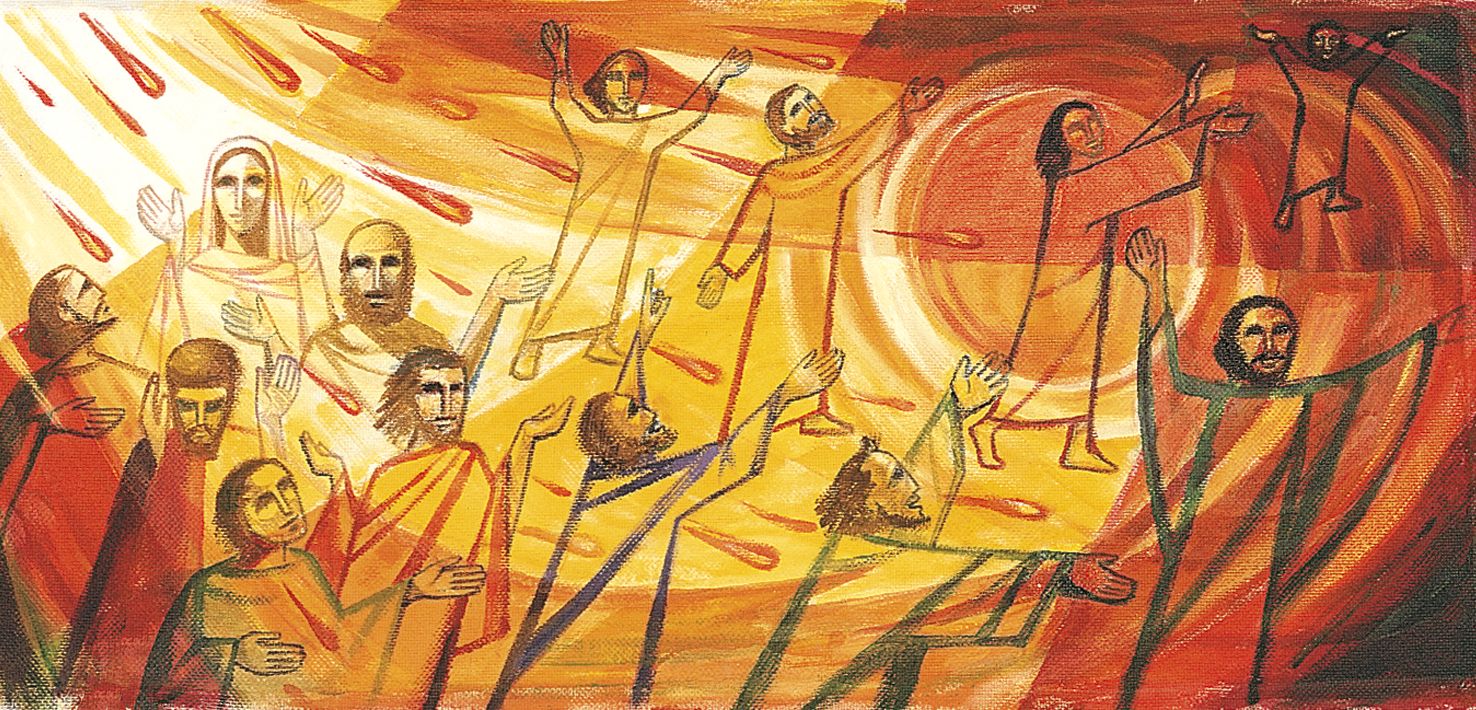
According to the passage, the entire community is baptized into the realm of the Spirit. The word for Pentecost (literally, “fiftieth day”) was used by Jews for a harvest festival more commonly known as the “Feast of Weeks”. The image of “tongues of fire” and the flames that are often used to symbolize Pentecost (as well as our own denomination) echoes the fire that was frequently used in Jewish and Greco-Roman writings as a metaphor for the experiences of prophetic inspiration.

The “gift of tongues” should not be confused with the spiritual gift of glossolalia that concerns Paul in 1 Corinthians 12-14. The Pauline meaning denotes a special language given to a few believers by the Spirit in order to edify the whole congregation. For the writer of Acts, though, this Spirit came upon all, rather than merely a chosen few. In many ways, the Pentecost experience of “tongues” has more to do with hearing and understanding than with speaking. It has to do with rhythm—that underlying rhythm that is part of us all, the rhythm that is God, our Source and Sustainer. So, the Pentecost story is about unity.

So God’s Spirit is poured out upon a community of believers. The Holy Spirit is not a “personal” gift from God. There is nothing personal or private (and certainly not restrictive) about it. The church has always tended to be comfortable with worshiping the Father and the Son but often the Holy Spirit is seen as a sort of marginal, misunderstood entity. But it is clear from this story that the arrival of the Holy Spirit is not hidden from view. The Spirit’s arrival is a noisy affair with special effects that draw an interested public “from every nation” to the community.

This arrival of the Spirit completes the picture—God created, redeemed, and is now empowering the people of God to be who God created them to be. This is the way that God sustains us in this world and the next. The Spirit does not imply a ghostly-type image. Talking about Spirit is talking about God. The Hebrew word for it is ruah–God in power like the force of wind or in intimacy like breath, the very essence and being of God. This is not speaking of bits and pieces of God. This is the fullness of God. This is God’s Kingdom coming. Pentecost is hope at its deepest level and the promise that everyone can be ignited by the Spirit in order to live out their God-called life. Nothing but fire kindles fire.

Pentecost did not create a church. This is not merely the church’s birthday. Pentecost is the point at which God’s very Spirit was breathed into the world and equipped us for work. Last week, we read of Christ’s Ascension, that holiest of absences that left a veritable void in the Gospel story. And so we waited. What Pentecost tells us is that we are the ones for which we’ve been waiting. It is not meant to be a feel-good, warm-fuzzy kind of day. The Holy Spirit is risky and sometimes painful, bringing about change and out and out revolution. The Holy Spirit invites failure rather than promises success, compels discomfort, rather than consolation. The Holy Spirit is not something that we just try on for size; it is tongues of fire that consumes us and leaves nothing behind except what was supposed to be in the first place—the ones for which we’ve been waiting.   In a 2007 commencement speech, Richard Lederer said “Let there be no distance between who you are and what you do.” That is our calling; that is what Pentecost is about—shrinking the distance between how we live and who we are called to be. So, get started…

Several years ago, I had an experience that, for me, gave life to this Pentecost story. I was traveling through Hungary as part of a church choir tour and one of our singing opportunities was the Sunday morning worship service of a small, extremely poor Protestant church on the Pest side of the city. No one in the small congregation spoke any English. We, of course, did not speak Hungarian either. You have to understand that the Hungarian language is usually grouped closely with Finnish because of its syntax, but it has so many words and sounds that are borrowed from Turkish as well as centuries of various gypsy languages that it has no real commonality with any language. So, our communication was limited to hand signals, nods, and smiles. The entire worship service was in this language that was more unfamiliar than anything that I had ever heard. We went through about an hour of unfamiliar songs, foreign liturgy, and a 30-minute sermon that meant absolutely nothing to us.

At one point I looked around and realized that they had their heads down and were speaking what must have been a common prayer. We put our heads down. As I sat there, praying my own prayer along with them, I was suddenly aware that something had changed. I still, of course, could not understand the words but somewhere in there I had heard something inherently familiar. I looked at the person next to me and said, “That’s the Lord’s Prayer.” I started with the second petition of the familiar prayer and slowly those around me began to join in. When we came to the end, there was sort of a stunned silence around us. We had all finished at the same time.

This was not a case of my somehow miraculously understanding a language that I did not know. It was, instead, a hearing of an incredible rhythm that runs beneath all language and connects us all. That rhythm is the Spirit of God. I realized at that moment that the point of the Biblical Pentecost story was not the speaking, but the hearing and the understanding.   Regardless of our differences, there is one common voice that connects us all, if we will only listen. (Shelli Williams)      

  1. What is your response to this passage?
  2. What is your image of the Pentecost experience?
  3. What lessons could we learn from the Pentecost experience?
  4. What is your response to the Lederer quote about the distance between who we are and what we do?


 NEW TESTAMENT: Romans 8: 22-27

To read the Lectionary Epistle passage, click here

This passage is a well-known depiction of God’s ongoing Creation. Like labor, both church and Creation long for the new life to arrive in its fullness. But it is not an “either / or” notion—Creation is ongoing, the coming of God’s Kingdom is both already and not yet. In fact, Creation is groaning through the birth of what it is to be even now. We understand that. Our own groans about what is wrong with the world, what is wrong with our country, what is wrong with the United Methodist Church are heard even now. What if we thought of those groans as the rumbling of the Holy Spirit as it is poured into our lives?

But God, as loving parent of all Creation, puts a mighty arm under the fractured Creation, not merely preserving it and protecting it, but setting it free to be. (This flies in the face of dualistic understandings of earth and heaven or mind and spirit. It does not speak of “rescuing” or even “saving from”, but adoption, redemption, freedom.) It is not God turning away from what is wrong with the world but picking it up and pulling it into being. In Feasting on the Word, Clayton J. Schmidt refers to Peter Storey’s notion of this “great nevertheless of God.” Schmidt says that “at first glance, [the world] seems full of angst: groaning and travail, unfulfilled longing, unseen hope, concerns too deep for words. But the hope here can be put in terms of what Peter Storey has called “the great nevertheless of God.” [Storey] developed this idea while serving as bishop of the Methodist Church in South Africa during the struggle against apartheid. Even while surrounded by the strong-armed agents of repression, Storey knew that the Holy Spirit was active in his nation. The government had all the power; nevertheless, God was with the poor in South Africa. The South African regime did not hesitate to use force in order to stop rebellion; nevertheless, Storey, along with Desmond Tutu and others, led the black South Africans in a peaceful revolution. The odds were heavily against the peaceful revolution; nevertheless, with God on their side, they were victorious. In the end, there was strong temptation to retaliate; nevertheless, God gave them a means of forgiving enemies and forming a reconciled nation. No matter what the odds, if God is in something, no obstacle can block the great nevertheless of God.”

Paul’s Letter to the Romans is considered his masterpiece. In it, he contends that all those who are indwelt with the Holy Spirit are shaped for that eternal glory that is already theirs in Christ. We are not alone. No matter how difficult life gets, we are supported by God’s Spirit. The Spirit teaches us and reaches for us even in our weakness. The phrase “we do not know what we ought to pray” is often used to support the notion of speaking in tongues, but it is more likely that Paul is just trying to make the point that life is difficult, full of limitations, and that no matter what, we remain secure in the Lord. Instead, God knows our mind, knows what we pray, knows what we need, if we are just open to what God provides us. Marjorie Thompson says of prayer, “Perhaps our real task in prayer is to attune ourselves to the conversation already going on deep in our hearts. Then we may align our conscious intentions with the desire of God being expressed at our core.”


  1. How does this passage speak to you?
  2. What images of Creation does this passage bring about?
  3. What does this say to you about prayer?
  4. What does this say to you about how we should look at the way the world is and our part in it?

GOSPEL: John 15: 26-27; 16: 4b-15

To read the Lectionary Gospel passage, click here

The word for “Spirit” here is “parakletos”, or paraclete. It has a range of meaning that includes advocate, encourager, comforter, helper. A paraclete was a patron or a sponsor that would speak and advocate on behalf of another. In other words, the Spirit, parakletos, advocates on behalf of Christ and on behalf of that for which Christ stood and taught and died. So the Spirit will enable the disciples to grasp what they had not gotten before, to grasp what Jesus was all about. The Spirit is a way of talking about God not as an other-worldly being, but as our companion. It is a redefining of truth.

Keep in mind that when Jesus returned, he did not find the disciples out doing what needed to be done. Instead, he found them huddled in a room, scared to death at the prospect of what might happen to them. So this is the promise that they are not alone, that God will see that they are equipped and empowered to do what needs to be done in the world. But it won’t happen unless Jesus leaves. Otherwise, they’ll just stay shut away from the world waiting for Jesus to show up and fix things.

But empowered by the Spirit, we are to make a case for Jesus in the world. Jesus is both fully absent and fully present. That is our mission—to become the hands and feet and voice and life of Christ in the world. It entails exposing sin as the killing of love, or God in Christ. It means exposing Jesus for the way Jesus was. Spirituality, then, is a way of advocating for God in the world, entering the advocacy and comforter that is God. God so loved the world. Human beings did not recognize that love. They killed it. God reaffirmed it. We can receive it, share it, and ourselves become advocates for that same love and life in the world, accompanied by the Holy Spirit. It’s not a matter of knowing everything to do; it’s a matter of knowing where to look for the strength that you need to be the change that you hope to see in the world.


  1. What meaning does this passage hold for you?
  2. What does the Holy Spirit mean for you?
  3. So what makes us uneasy about the concept of the Holy Spirit?
  4. What does it mean to you to talk about Jesus as both fully absent and fully present?
  5. What do you feel that you are empowered to advocate in the world?


“The celebration of Pentecost beckons us to keep breathing. It challenges us to keep ourselves open to the Spirit who seeks us. The Spirit that, in the beginning, brooded over the chaos and brought forth creation; the Spirit that drenched the community with fire and breath on the day of Pentecost: this same Spirit desires to dwell within us and among us.” (From Jan Richardson, The Painted Prayerbook, available at http://textweek.com/, (Pentecost A) accessed 7 May 2008.)


Some Quotes for Further Reflection:

God creates us, Jesus leads us, and the Holy Spirit shows us ways that are not always in the book. (Joan Chittister, In Search of Belief, p. 161)


Try, with God’s help, to perceive the connection—even physical and natural—which binds your labor with the building of the Kingdom of Heaven; try to realize that heaven itself smiles upon you and, through your works, draw you to itself; then, as you leave church for the noisy streets, you will remain with only one feeling, that of continuing to immerse yourself in God. (Pierre Teilhard de Chardin (1881-1955))


The Spirit of God is like our breath. God’s Spirit is more intimate to us than we are to ourselves. We might not often be aware of it, but without it we cannot live a “spiritual life.” It is the Holy Spirit of God who prays in us, who offers us the gifts of love, forgiveness, kindness, goodness, gentleness, peace, and joy. It is the Holy Spirit who offers us the life that death cannot destroy. Let us always pray: “Come, Holy Spirit, come.” (Henri J.M. Nouwen)


Closing


Spark of God, Spirit of Life! I remember and celebrate your dwelling within me.


Divine Fire, you never waver in your faithful presence. Amid the seasons of life, you are my inner illumination.


Ever-present Light, the spark of your inspiration has been with me in every moment of my life, always available to lead and guide me.


Eternal Joy, the dancing flames of your joy are reflected in my happiness and in the many ways that I delight in life.


Spirit of God, your fiery presence gives me passion for what is vital and deserving of my enthusiasm.


Blazing Love, the radiant glow of your compassion fills me with awareness, kindness, and understanding.


Purifying Flame, your refining fire transforms me as I experience life’s sorrow, pain, and discouragement.


Radiant Presence, your steady flame of unconditional love kindles my faithful and enduring relationships.


Luminous One, you breathed Love into me at my birthing and your love will be with me as I breathe my last. Thank you for being a shining Spark of Life within me. Amen.


(Joyce Rupp, in Out of the Ordinary: Prayers, Poems, and Reflections for Every Season, p. 199)