Easter 5B: Unless Someone Guides Me

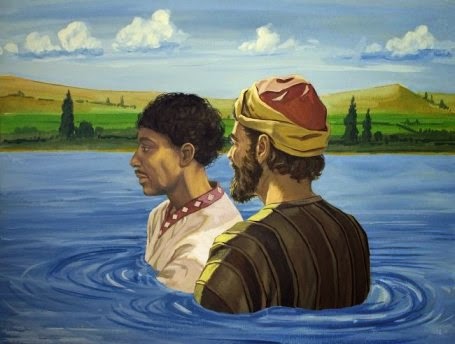
philip_ethiopian2FIRST READING: Acts 8: 26-40

To read the Lectionary passage from Acts, click here

In this part of Acts, the author tells of the spread of good news to non-Jews in the Middle East. The writer has just finished telling about the spread of the gospel to the Samaritans and now we hear of the conversion of yet another outcast, a eunuch. (Per Deuteronomy 23:1, a eunuch could not be admitted to the assembly of the Lord. The eunuch is from Ethiopia. The “angel” is essentially an agent of the Lord of some sort that leads Philip to Gaza down this wilderness road. He comes across this eunuch, who was the financial officer for Queen Candace. He finds the eunuch reading from the Book of Isaiah. A few things can be surmised from this. First of all, the eunuch is probably an admirer of Judaism, although he cannot participate in its practice. Secondly, the eunuch is well-educated and probably fairly successful (since he is so high in the queen’s court.)

Philip proclaims the good news by showing the eunuch how the prophesies of the Old Testament are fulfilled through Christ. He tells the eunuch about Jesus. When the eunuch asks for baptism, Philip obliges. At that point, Philip is in some way whisked or carried or snatched or in some other way compelled away, where he finds himself in Azotus, proclaiming the good news to more non-believers.

The eunuch is cut-off from society, shunned. And yet, in the story of Jesus, he found a place. Here, human humiliation becomes the point of entrance for relationship with God. He was obviously open to this encounter, perhaps even deeply wanting it, since he was reading the Scripture. One interesting thing is that the eunuch did not ask for a teacher. He asked for a guide—someone to travel with him, rather than telling him where to go. Perhaps he already had this God-thing figured out.

From the standpoint of Philip, keep in mind that he had always been taught to be prejudiced against eunuchs and probably against blacks. This man was from Ethiopia; he was not like Philip. Perhaps God puts those who are different in our path to remind us that it is not our job to define the Kingdom of God. There are no membership cards. It’s just that often the church has to be poked and prodded beyond its comfortable walls.

The truth is, this IS a story of conversion, but not the story of the conversion of the eunuch. It is, rather, Philip’s conversion, the story of how he left his prejudices and his cultural preconceptions, his fear of those who are different, behind and instead followed the call of the Gospel. It is the story of Philip becoming who God called him to be.

But, truth be told, all of us struggle with that. After all, it’s much more comfortable, much more validating, to surround ourselves with those like us. And yet, how does that change us? How does that change the world? If we surround ourselves with mirrors, with those things that look and act like us, that reflect only who we are, how will we ever know how God is calling us to change? How will we ever know who God is calling us to be beyond ourselves? So, who’s to say? Who’s to say who can be baptized? Who’s to say who God loves? Who’s to say who has the right image of God? The truth is, we don’t know. It’s not ours to say.

The truth is, none of us have it figured out. None of us even come close to having possession of this wild and untamed Holy Spirit through which we live and move and have our being. None of us can ever limit the Christ that lives even today in this world. And none of us will ever completely know God. The best we can hope and pray for is that we will finally come to know that part of God that God has revealed in our lives. And in the meantime, we are called, called to be the people of God building the Kingdom of God. In the meantime, we are called to break the mirrors that limit who we are and follow where God leads.

  1. What is your response to this passage?
  2. Where do you see similarities in this story and our society today?
  3. How does that speak to outcasts today?
  4. How comfortable are you leaving your “mirrors” behind?


NEW TESTAMENT: 1 John 4: 7-12

To read the Lectionary Epistle passage, click here

This passage can be summed up in three words: “God is love.” This love originates in God This is the kind of love we have for each other. Being lovers, then, we are God’s children and we love God. If we don’t actively love, we don’t know God – because the very nature of God “is love”. God’s greatest expression of love for us, the Church, was sending Christ, sending the very Godself, into this far-from-perfect world, thereby giving us a way to know and live as God envisions. God took this initiative, this action restoring us to unity with God. So we have a duty to love each other. It is through Christ that we can see God. The flip side is: if we love each other, God (i.e. God’s Love) is “in us”: fraternal love completes God’s vision of total love.

This is obviously sort of a circular depiction of God’s love and God’s vision of who we are. But, here, the aim of love is to enable people to live, sharing life and love in the name of God with each other. Implicit in this passage is the assumption and the directive that we will love those even that we do not see, that we will love someone not because of who they are but simply because they “are”. So, from that standpoint, the shape of God’s love is continually changing, continually growing within us. As we encounter more and more of those whom we should love, God’s love grows beyond our own limitations.

If it is true that the very core of the universe is love, then God wants us to grow in love. In the Bible, God does not command us, “grow in intelligence.” If the very core of the universe was intelligence, then God would have said, “get smarter and smarter and smarter.” But God does not say that in the Bible. If the very essence of the universe was power or wealth, then God would BE power and wealth. But because the core of the universe is love, and God is love, then God wants us to be like God; to be more loving. God wants us to experience love, to grow in love. God’s command to love is simply the command to be who we are supposed to be, who God created us to be in the first place.

  1. What meaning does this passage hold for you?
  2. How can this speak to us today?
  3. Why is this such a hard thing for many people to grasp?
  4. What does it mean for you to experience the “love that is of God”?


GOSPEL: John 15: 1-8

To read te Lectionary Gospel passage, click here

The passage begins with a familiar image: the vine. Perhaps the “true” vine is the writer’s way of distinguishing this newfound faith in Christ from the image that was used for Israel. But the focus is probably more on the need to remain in the vine and bear fruit. Remaining in, abiding in, the vine is crucial for life. For the writer of this Gospel, salvation is a relationship with the Christ and God through Christ. So, using the vine image, branches need to insure that they remain connected.

The vine will be pruned or purified and new life will spring forth. Fruit-bearing probably refers to the bringing of others into this relationship with Christ. Evangelism which is not understood as abiding within the aspect of love becomes a form of manipulation. But, like a vine, we are all interconnected, nourished by God’s love. That is life. That is abiding. The whole thing is not about horticulture; it’s about abiding.

We love because God first loved us. Love is the highest form of abiding, of being present for one another. Thich Nhat Hanh says, “If our love is only a will to possess, it is not love. We must look deeply in order to see and understand the needs of the person we love. This is the ground of real love.”

In a commentary about this passage, Walter Wink says this:


What does it mean, “to abide”? Deep strata of memory are excavated by those words: a former piety, a profound but now defunct Christ mysticism, prayer without ceasing, attempts to implant myself in God and an entire libretto of frozen feelings, from “I tried that” to “pious claptrap” to “let’s get on with living in the real world.” For me “abide” once meant: Think only of Jesus. Drown out all other voices. Choke down the rebellion. Manhandle the resistance. Deny the inner darkness. For me, it all added up to a religion of repression.

But we grow with the text. I had somehow mislearned to regard the command to abide as a personal admonishment. I took the “you” as singular. My God and me, and all that. But that “you” is plural, providing a rich image of the body of Christ, of Christ seeking a body in the world. Had I thought of it as plural, I would have understood it as a reference to the church. Now I would leave it loose, to apply to anyone who abides, whatever his or her beliefs or affiliations….

In such a time, the words “As the Father has loved me, so I have loved you; abide in my love” .may not come as unmitigated comfort. Look at how God loved Jesus! From baptism to crucifixion, Jesus kept abiding, and the Powers maintained their menace. Did Jesus have to undergo pruning? Is that what the Temptation was all about? And Gethsemane? And how much more we never hear about? This pruning business can get a lot more painful than anything I’ve ever known.

Someone who does know more about the painfulness of pruning than I stresses that the pruning is not to be identified with an original act of trauma, abuse or injustice. Elaine V. Emeth says that the pruning metaphor works for her only if she thinks of God as a gardener who grieves while watching a violent storm rip through a prized garden. Afterward, the gardener tenderly prunes the injured plants in order to guarantee survival and to restore beauty and harmony. Pruning is not to be confused with the tragedies that overtake us; it has more to do with clearing away the debris they leave behind. (From “Abiding Even Under the Knife”, by Walter Wink, in “The Christian Century”, April 20, 1994 available at http://findarticles.com/p/articles/mi_m1058/is_n13_v111/ai_15177815/?tag=content;col1, accessed 6 May, 2008.)


  1. What is your response to this passage?
  2. What does it mean to abide in Christ? What does it mean to abide with each other?
  3. What image does the vine mean for you?
  4. How do churches today fall short of this image?


Some Quotes for Further Reflection:


God is always bigger than the boxes we build for God, so do not waste too much time protecting your boxes. (Richard Rohr))

We must love them both, those whose opinions we share, and those whose opinions we reject, for both have labored in the search for truth, and both have helped us in the finding of it. (Thomas Aquinas)


All your love, your your stretching out, your hope, your thirst, God is creating in you so that God  may fill you…God is on the inside of the longing.  (Maria Boulding)


Closing

Close by reading the excerpt from There Is a Season, by Joan Chittister, p. 111:

An ancient wrote:  Once upon a time a disciple asked the elder, “How shall I experience my oneness with creation?”  And the elder answered, “By listening.”  The disciple pressed the point:  “but how am I to listen?”  And the elder taught, “Become an ear that pays attention to every single thing the universe is saying.  The moment you hear something you yourself are saying, stop.”

Peace will come when we stretch our minds to listen to the noise within us that needs quieting and the wisdom from outside ourselves that needs to be learned.  Then we will have something of value to leave the children besides hate, besides war, besides turmoil.  Then peace will come.  Then we will be able to say…I fear nothing, I hope for nothing, I am free.

Proper 25A: Legacy

promisedland2528dtf_78232825291OLD TESTAMENT: Deuteronomy 34: 1-12

To read the Old Testament Lectionary passage, click here

We begin this week’s passage with Moses looking out over the horizon toward the Promised Land. It says he was one hundred twenty years old. Now, putting aside the fact that our current calendar and our current way of tabulating age was not in place, I think we at least get the message that Moses was nearing the end of his life. And as he looked out over the land, he reflected on the Divine Promise that had been so much a part of his life.

The Israelites are about to enter the Promised Land. They have wandered for forty years. (We skipped a lot of chapters in the Lectionary!) Most of the original generation is gone. Moses has been their leader; really, the only leader that they’ve ever known. And I’m sure they are getting concerned about who would replace him. How could they go on? But look how Moses responds to their concerns. He knows it’s not about him. (THAT is what is probably the mark of a great leader, when you come to think about it! Think about all of those leaders in our history that were instruments of vision and change but that never experienced that change themselves. They’re called prophets. ) He reminds them of the promise. Look, see there…everything for which we’ve worked, everything toward which we’ve journeyed, everything for which we’ve dreamed…there it is. It was a sort of sermon, a calling to belief, a reminder to the people of who and whose they were. This is Moses’ legacy.

Moses never actually entered the Promised Land. He would die here in Moab and be buried somewhere in this valley. There are some that would think that a shame that Moses would come all this way and then never see his dream to fruition. Maybe that was the whole point. This was Moses’ calling. He was to lead the journey. He was to lead the people into seeing what the Promise held, what the covenant meant in their lives. Moses did not need completion—just faith. Moses was entrusted with the vision to hand off to the people. And just before his death, Moses got something that he probably never dreamed he would even receive—a glimpse, just a glimpse of the Promised Land.

The Israelites mourned his death with the deep and profound grief that one would mourn a family member, a patriarch, one who had led them through so much in their lives, and who had been such an instrumental part in the change that they had experienced. After the period of mourning, they would embrace their new leader, Joshua, the son of Nun, who Moses had hand-picked. The text says that Moses had “laid his hands on Joshua”. It was an anointing of sorts. We Methodists might call it his ordination. “Go now and take thou authority…” Moses would never be forgotten but it was time to move from this place and carry that legacy that he had left them with them into the Promised Land.

We are given glimpses all the time of the Divine Promise. Most of us just spend too much time trying to figure out how to see it all through. When will that Promise, that cherished glimpse of the holy and the sacred be enough? When we will realize that God’s vision transcends us all?

 This saga of exodus and wilderness wandering is well known to us. It shaped our lives, formed our attitudes, made a deep imprint on our feelings. We cannot talk about freedom in the Western world without remembering this event. Promise, hope, and expectancy grew out of that exodus movement and wilderness experience.

The parallel of this wilderness promise to our time is obvious. In a real sense, we must now move through a wilderness as real as the Sinai wastes and ever more threatening. Ours is a perilous journey through the uncharted and unexplored reaches of a new age, a newcoming millennium.

Consider for a moment the wilderness in which we have wandered the past forty years, rebellion against leadership, cold wars and hot wars, natural disasters, ethnic cleansings. Unbridled lawlessness and senseless violence in city, town, and country has produced a jungle where no life is safe and no home secure. In these desert times, the old visions have faded in too many lives and the new vision isn’t clear. We build idols like the golden calf to enshrine some forgotten memory while we forget the God of our fathers and mothers and create new gods to our liking.

How do we state clearly what we believe? What quality will mark the 21st-century Christian life? Where does the church go now? We’ve traveled through the broad, howling desert of the late 20th century and strange to say, like the ancient Hebrews, we stand now on the edge of promise. There lies before us a choice of despair or hope, hypnotic fear or energizing courage.

The 20th century has produced a number of leaders in the likeness of Moses–Ghandi in India, Martin Luther King, Jr., in America, Nelson Mandela in South Africa, among others.

  1. King’s leadership in the non-violent movement for racial equality and human dignity is seen by many as a 20th-century expression which parallels in microcosm that of Moses. In King’s final sermon, “I’ve Been to the Mountain Top,” he said, “God has allowed me to go up to the mountain and I’ve looked over and I’ve seen the Promised Land. I may not get there with you. But I want you to know tonight that we as a people will get to the Promised Land. Mine eyes have seen the glory of the coming of the Lord.”
  2. King, like Moses, was denied the chance to enter a hoped-for promised land of freedom and justice for all. The day following his last sermon on a balcony outside his hotel room the crack of a rifle and an assassin’s bullet tragically ended King’s life and stilled his eloquent voice. But the dream of Martin Luther King, Jr., is not dead. His life and witness will remain forever a testament as one of the greatest of the 20th century.

We have moved through generations of racial tension and conflict, a wilderness of disruption and discord. Yet we stand now at the edge of God’s promise. At the end of the wilderness journey lies the promised land. I pray we shall not turn back into the desert lest we face another generation of terror or aimlessness, of fear and despair.

God invites us to enter a promised land where there is mutual acceptance, peace as a way of life, religion as encounter with a God who loves city and suburbs which move from jungle to neighborhood. Can we now begin to claim God’s promise? (From “Through the Wilderness to Promise”, a sermon by Rev. Dr. William K. Quick, available at http://day1.org/713-through_the_wilderness_to_promise, accessed 15 October, 2011.)

  1. What is your response to this passage?
  2. How would you reflect on Moses’ leadership?
  3. How would you reflect on Moses’ faith?
  4. What does this passage say about God?
  5. How does this passage speak to our world today?


 NEW TESTAMENT: 1 Thessalonians 2: 1-8

To read the Lectionary Epistle passage, click here

First Thessalonians is thought by most scholars to be the oldest epistle in the New Testament. So, there’s sort of an underlying question of what exactly it means to be an apostle, to be a member of this Christ community, that seems to be working itself out. These were not easy times. The early Christians were being shunned and mistreated throughout the region. Paul was trying desperately to get them to hold onto their newfound faith even in the face of such fierce opposition. And he was citing his own ministry and the courage that he had had before God. He affirms the people in their ministry as those “approved by God”. It is a way of reminding the people that they are called to be God’s people even in light of the difficulties that this world might bring.

The idea of God “testing our hearts” is probably difficult for many of us. Does that mean that what these first century hearers were enduring and the difficulties that we may have are a “test”? But remember that testing is a theme that we see over and over in the Hebrew tradition. And again, maybe testing is more like a “chemical test”—a mode of change–rather than a math test. It’s not that there is a right or wrong answer, per se. But this is God’s way of building us up, of changing us into the people that we are called to be. I don’t think God sends us suffering—God just helps us journey through it to the promise at the end.

Paul goes on to remind people that he and his followers were not seeking honor or flattery. In other words, contrary to some of the “false preachers” of that day (and ours!), they were not in it for money or fame or status. Rather, Paul uses the image of a compassionate nurse who is caring toward everyone. But toward his or her own children, the nurse’s caring goes even beyond the expected. It is such a deep and profound sense of compassion and tenderness that the nurse is willing to do absolutely anything for that child. It is THAT level of compassion and caring that Paul felt for these new believers. This was not a “right or wrong” answer for which they were being tested. Paul was so called to help them be who God was calling them to be that he was willing to walk through anything with them to see that that happened.

Paul did not just start a Christian community and then leave them to their own devices. He loved them. He wanted to see them become who they were called to be. And as Christians, we are all called to be like that toward each other. This is not an individual “test” or “race” that we are trying to complete. It is the vision of God that we are called to show to all. We are one body—the Body of Christ. We are interconnected at a deeper level than any of us can probably even fathom. We are called to care for one another. But we are also called to encourage one another, to lead one another, and to be with one another through the journey.

The truth is that this life of living and witnessing to the Gospel of Jesus Christ is a difficult life. We were never promised an easy road. Like Moses, our journey is one that meanders and winds as we strain through perilous mountains and morose valleys, sometimes having to cross even treacherous gulfs. Paul knows this. He has lived it. And he is reminding the believers in Thessalonica of that very thing. Because if we just persevere on the journey, the glimpse of the Promised Land is always in sight.


  1. What meaning does this passage hold for you?
  2. What insights do you have about the notion of God “testing our hearts”?
  3. How are Paul’s words relevant today?
  4. What does this say about the faith community and what, as a community, it is called to be?
  5. How does this passage speak to leadership?


 GOSPEL: Matthew 22: 34-46

http://bible.oremus.org/?ql=280900349

This passage comes as part of a long dispute between Jesus and what seems to be everyone else—Pharisees, Sadducees, lawyers, chief priests, and even the disciples. The question that the lawyer poses to Jesus is, of course, to test him. After all, Jesus was a teacher, a rabbi. He should be able to give the right answer. This was one of the final challenges to his authority. In the context of the Gospel by the writer known as Matthew, this is Jesus’ last encounter with those who saw it as their role to protect the tradition of the first century Jewish religion. After this, the Gospel moves into the judgment of Jesus and then on toward the Passion and Resurrection of Christ. In a way, this was the final test, sort of a pop quiz that they thought would surely trip Jesus up once and for all. (So, is that your FINAL answer?)

The lawyer who stepped forward could be considered the expert on the Torah, the professional theologian and the resident authority on all things of the faith tradition. And his purpose was to test Jesus, to trap him into giving an answer that would finally prove that Jesus was not who he had made himself out to be. For the writer of Matthew, this was a test of the kingdoms pitted against each other—the Kingdom of God against the powers that were in play on earth. The rabbinic tradition had counted a total of 613 commandments in the Torah, the “Law”. And even though it was acceptable for rabbis to give summaries of the Law itself, the view was that each one of these commandments held equally important value. By asking Jesus which law was the greatest, the lawyer was setting a trap. If Jesus singled out any one law above the other, it would be like dismissing the other 612. It would be a violation of the Law of Torah. It would be his final answer, indeed.

But Jesus, in true Jesus fashion has an answer that they were not expecting. “You shall love the Lord your God with all your heart, and with all your soul, and with all your mind.” The first commandment that Jesus cites is known in Judaism as the Shema, the central prayer of the Jewish faith. It would be hard to refute. Found in Deuteronomy (6: 4-9), the commandment that Jesus gives is part of what is found in a mezuzah, the holy parchment affixed to the doorframes of Jewish homes. It declares not only the belief in the One and Only God but also calls us to a deep and abiding relationship with God. We are called to love God with our whole heart, a pure and absolute devotion to God as our one and only maker and redeemer. We are called to love God with our souls, to long for a passionate and engaged love for the One who nurtures and sustains us. We are called to love God with our minds, not a blind and uninformed faith but one that questions, and learns, and grows into what God envisions us to be. And we are called to love God with all our strength, every fiber of our being, a full and engaged life lived in the name of Christ our Lord.

But then Jesus comes back and tells us that we “shall love our neighbor as ourself.” In essence, it seems that Jesus was asked for one commandment and responded with two. But the writer of Matthew’s Gospel depicts the second as “like” the first. The Greek word for this does not mean merely similar; it means, rather, that is of equal importance and inseparable from the first. The great command to love God has as its inseparable counterpart the command to love neighbor.   One cannot understand true and abiding love without a loving relationship with God. But one cannot realize that relationship with God without loving one’s brothers and sisters and realizing that we are all children of God. From this standpoint, our mutual and shared humanity becomes part of our relationship with God, as we are swept into the coming of the Kingdom of God for all of Creation. We are called to love our neighbor as deeply as we love ourselves, to meet our neighbor’s needs as readily as we meet our own, and to seek to understand our neighbor’s dreams and passions just as we vie for what we believe. We are called to love our neighbor because we love God. The two commandments are intrinsically intertwined, inescapably linked to one another. They become reflections of each other in true Trinitarian mutual relationship. They are of one essence and being. Our love and compassion for others gives visibility to our love and compassion of God.

So, the point is that Jesus was not giving us two answers. And, contrary to what those learned and educated first century theologians may have wanted or tried to assume, I don’t think it was Jesus’ intention to dismiss the other 611 Laws of Torah. The answer that Jesus gave was what all of Torah was about. The answer that Jesus gave is what we are all about. Love of God and Love of neighbor—that is what the Kingdom of God is and when we get to the point where we understand what it means to live into that full and abiding love, then we will understand what living in God’s Kingdom is about. Edward Markquart calls these two-in-one commandments the hinges of a door. A door cannot work properly with only one hinge, only one range of motion. It takes both—love of God and love of neighbor working together in one continuous and fluid motion to open the door to the Kingdom of God.

After this, Jesus poses them a question. Here you go…if the Messiah is the son of the Psalmist David, then how and why would David call him Lord? No one had an answer. After all, Jesus had already turned them completely on end with the previous dialogue. Maybe there were afraid to speak up and be quashed again. Maybe they were just trying to figure it all out. Or maybe this was the moment when they actually got it. The controversies come to an end. The words stop. And at this point in the Scripture, the drumbeats in Jerusalem begin.


  1. What meaning does this passage hold for you?
  2. What does the “great commandment” mean for you?
  3. How does this speak to our world today?
  4. Why is this so difficult to put these together?


Some Quotes for Further Reflection:


Well, I don’t know what will happen now. We’ve got some difficult days ahead. But it doesn’t matter with me now. Because I’ve been to the mountaintop. And I don’t mind. Like anybody, I would like to live a long life. Longevity has its place. But I’m not concerned about that now. I just want to do God’s will. And He’s allowed me to go up to the mountain. And I’ve looked over. And I’ve seen the promised land. I may not get there with you. But I want you to know tonight, that we, as a people, will get to the promised land. And I’m happy, tonight. I’m not worried about anything. I’m not fearing any man. Mine eyes have seen the glory of the coming of the Lord. (From “I’ve Been to the Mountaintop”, a speech by Dr. Martin Luther King, Jr., April 3, 1968. King was assassinated the next day.)


Fools and fanatics are so sure of themselves but wise souls are so full of doubt.(Russell Bertrand)


The rare moment is not the moment when there is something worth looking at, but the moment when we are capable of seeing. (Joseph Wood Krutch)


Closing


Thou who art over us,

Thou who art one of us,

Thou who art;

Give me a pure heart, that I may see thee;

A humble heart, that I may hear thee;

A heart of love, that I may serve thee;

A heart of faith, that I may abide in thee. Amen .

(Dag Hammerskjold, 20th cent., UMH # 392)