Proper 6C: Unauthorized Faith

RulesFIRST LESSON:  1 Kings 21: 1-21a

To read the Old Testament passage

Throughout several chapters in this First Book of Kings, the prophet Elijah opposes King Ahab, ruler of the Northern Kingdom of Israel because of his support of the Canaanite god Baal.   From that point on, Ahab and Elijah are in constant conflict over what is right in the eyes of the Lord.  In this passage, Ahab tries to secure the vineyard owned by Naboth.  Naboth refuses, since the vineyard is part of his family land, his inheritance.  There doesn’t seem to be any real coercion, since Ahab first offers to give Naboth a “better vineyard” or to pay him what the vineyard is worth.  Now you have to understand that a vineyard was a prize property.  The thought of turning it into a vegetable garden probably would have been a slap in the face for Naboth.  In fact in Deuteronomy 11, Egypt was likened to a vegetable garden while Israel was depicted as a vine (as in a grapevine).  So, with this tradition, the idea of a vegetable garden would have been particularly insulting.

Ahab becomes depressed because of Naboth’s refusal.  So Ahab’s wife, Jezebel, prods him to step up and claim it.  After all, Naboth is in charge; he is the king with all of the power that comes with that.  Then Jezebel devises a plan to bring false charges against Naboth and take him out of the picture.  When the plan is carried out and Naboth is killed, the elders let Jezebel know of their success.  Once Jezebel’s plan is accomplished, Ahab moves in to take possession of the vineyard.  The rest of the passage depicts Elijah’s condemnation of Ahab for his actions.

The whole story could be likened to the tale of King Midas, who was destroyed by his insatiable desire for more and more wealth in spite of the fact that he already had more than he needed.  It doesn’t even seem that Jezebel really even cares about the vineyard; she just wants Ahab to stand up and exercise his power; she just doesn’t want to lose.

The story is a reminder to us of what unbridled and corrupt power can do.  It is a story of the powerful over the powerless.  Keep in mind here that Ahab was the king over Naboth.  As king, he was entrusted with Ahab’s care, responsible for what happens to him.  The story is also a reminder to us that whether or not we intend to hurt others, if we allow them to be hurt for our gain, then we are complicit in the crime.  The ending may seem to be a little discomforting for us.  Because of what Ahab did, Elijah is pronouncing judgment—disaster, if you will.  Ahab has brought disaster; he will reap disaster.  It is a reminder that nothing good comes from trying to hurt others, trying to elevate oneself and one’s position at the expense of others.


1)      What is your response to this passage?

2)      What does this say to us about power?

3)      In what ways do we identify with this passage in today’s world?

4)      What is your feeling about the pronouncement of disaster in response to disaster?

5)      What does this say about the gifts that God has given us?  Why was Naboth so adamant about not relinquishing the land?

6)      What does it say about our responsibility and care for those over whom we intentionally or unintentionally have power?  Who are those in our world?  Who are the Ahabs and Jezebels?  Who are the Naboths?  What part do we play?


NEW TESTAMENT:  Galatians 2: 15-21

To read the Epistle passage

Paul has had lots of problems in Galatia.  He saw that he was called to evangelize Gentiles and he did so without requiring circumcision or keeping the food laws as they were laid out in the Torah.  Essentially, he was telling them that they could have a relationship with God without having to follow all of the rules that had been in place for so long.  When questioned, he declares his own authority to be independent of any human being or human construction.  Well, of course, there were those that were unhappy with this.

Paul is trying to set everyone straight.  He is trying to clarify the relationship between law, faith, justification, and the cross.  For him, the works of the law do not affect justification.  Justification is not a “turning back of the clock”, so to speak, but about change, about the reckoning of who we are before God.  Paul is not just interested in creating righteous and right individuals; he wants to create justice for all.

Paul doesn’t have a problem with the law, per se; in fact, he was a zealous follower of it prior to this.  He’s just realized that there is something more.  He’s realized that God is not calling us to separate the circumcised and the uncircumcised, the “haves” and the “have nots”, the “rule-followers” and the “rule-benders”.  Paul understood faith as joining oneself to Christ, to share in his death of what we know, and to share in his rising to new and eternal life, rather than merely following a checklist of rules.  Paul saw this as available to all.

Paul saw the “rejection” of the law as a source of righteousness.  His view of faith and righteousness would become the way all is measured, the lens through which we view many of the other stories in the Bible.  His “rejection” was not a shunning of the law but a way of carrying it beyond what we know.  Paul’s contention was that if life was only about the law, it would be nothing and Christ’s death would be meaningless.

You can’t help but look at this as a commentary on the church, even on today’s church.  Lest we chalk this up to a sermon from Paul against Jewish legalism, think again.  Perhaps we need to read it not as a statement against Jewish legalism, but rather against ours.  What “rules” do we impose?  What do we require so that everyone essentially looks and thinks like us?  In other words, how open was the church to that first uncircumcised, non-Jewish follower that wanted to join the first century church?  And how open are we today?  What ranting from Paul would we hear?  The truth is that the rules and the dogma are not bad.  They give us a framework, sort of help us “stay on track” if you will.  But when they become exclusionary, they need to be reworked.  After all, it’s not about doing the right thing.  It’s about grace.  And perhaps God is not the only one who should be dispensing unlimited grace.  The rules aren’t bad; they are just not in finished form.  Continued circling back or circling around them just doesn’t work.


1)      What meaning does this passage hold for you?

2)      What, for you, is the difference between following the law and living a life of faith?

3)      What does faith mean for you?

4)      What message would Paul have for our modern-day church?


GOSPEL: Luke 7: 36-8:3


To read the Gospel passage

This passage is either the third or fourth time we’ve read an account of this in this Lectionary year.  You can talk about the woman’s faith or the woman’s love or the woman’s extravagant generosity.  Or you could turn it around and talk about rules.  In this Gospel passage, we are given lots of rules.  It starts at the beginning when it tells us that Jesus “took his place at the table.”  He took his place as if there was a designated place where he was supposed to sit.  It was probably, you could surmise, toward the head of the table to the right of the host.  Isn’t that what the rules of etiquette usually tell us?

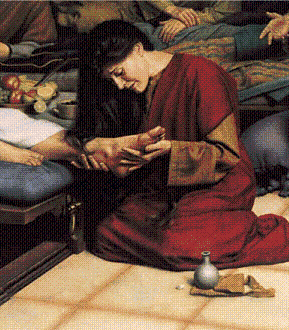
And then this woman enters—a woman already defined by the community and now by Scripture as a “sinner”.  Somewhere along the way she had apparently broken some rule of conduct and violated what would be considered an acceptable way of living and being.  And now she is apparently interrupting what is probably a perfectly-choreographed event in the home of one of the most respected religious leaders.  She desires to anoint Jesus’ head with oil.  But standing nearer Jesus’ feet, she is suddenly overcome with emotion and begins to weep.  She begins to wash his feet with her tears, takes down her hair to dry them and then kisses them and pours the anointing oil on them.  What a spectacle that must have been!  And right here in the home of this respected Pharisee!

And so the Pharisee not only pronounces judgment on the woman, but also on Jesus.  After all, they had both broken the rules!  Women of questionable reputation did not act like this and if Jesus was really who he claimed to be, he would have known better.  But Jesus’ response is not the apology that the Pharisee and his “respectable” guests probably expected.  Instead Jesus challenges Simon’s pronouncement of both of them by launching into a parable about forgiveness.  And woven through the parable are reminders of what the woman did.  She openly and generously gave of herself, more than anyone else at the table had done.

Jesus is trying to make them realize that there is something more than rules, there is something more than religion, and there is something more than doing the “right thing”.  Ralph Waldo Emerson said that “the faith that stands on authority is not faith”.  I think that is what Jesus is trying to get across.  Faith is not about rules.  The woman’s intense act of love beyond all reasonable expectations and all acceptable actions becomes a means of grace.  It leads us to God.  It shakes us out of our comfort zones of what is normal and expected and even acceptable because, when you think about it, Jesus was very seldom normal and expected and even acceptable.  Instead he showed us how to step out of our boxes and live a life of faith—real faith that is untamed and uncontrolled and virtually undefined, a faith that rips open our carefully-sewn-together lives just enough to let God’s presence spill into them.

Religion and faith are not the same thing.  Religion is about what we believe and why we believe.  It is about tradition, the institution, the system, and, yes, the rules.  When you think about it, our religion has been constructed over centuries.  It has given us creeds and liturgy and definitions of God.  It gathers us and grounds us and reminds us of a world to come.  It gives us commandments and rules that guide the way we live so that we can become what we seek, so that we can journey toward a oneness with God.  It is meant to lead us to God, not pave the way or drive us there.

Somewhere in the midst of those rules we, like Jesus, have to do a little bending.  We have to at some point move beyond and transcend the rules and rituals.  We have to look beyond where we are to that place to which God calls us.  That is where faith comes in.  That is where God, greater than any religion, meets us.  In her book, Called to Question, Joan Chittister says that “in order to find the God of life in all of life, maybe we have to be willing to open ourselves to the part of it that lies outside the circles of our tiny little worlds.”  She goes on to tell a Sufi tale of disciples who, when the death of their master was clearly imminent, became totally bereft.  “If you leave us, Master,” they pleaded, “how will we know what to do?”  And the Master replied, “I am nothing but a finger pointing at the moon.  Perhaps when I am gone you will see the moon.”  The meaning is clear:  It is God that religion must be about, not itself.  When religion [or rules] makes itself God, it ceases to be religion.  But when religion becomes the bridge that leads to God, it stretches us to live to the limits of human possibility.”  (Joan Chittister, Called to Question:  A Spiritual Memoir, (Lanham, MD:  Sheed & Ward, 2004), 19-20.)

Chittister maintains that “religion ends where spirituality begins.”  From that standpoint, these rules, these dogmas, all of these things that make up our religion are not our faith journey, but they lead us through it.  They are, from that standpoint, a means of grace.

And as we change, as our journey changes, as our context changes, perhaps we are sometimes called to the act of bending rules.  It doesn’t mean that we’re dismissing them or ignoring them.  It means that we are allowing the conversation about God to continue.  But more important than that, it means that we are becoming part of the conversation.  We are becoming part of the journey.

Jesus wasn’t shunning the rules that had been a part of the faith tradition for as long as anyone could remember.  He was just bending them a bit, making them a bit more pliable, a bit more nimble, a little bit more transcendent, a little bit closer to what God had in mind.  The rules are meant to be foundations on which we can stand and through which God is revealed.  But when they become boundaries that control who is welcome and who is accepted, that is not what God is about.  So, Jesus didn’t really follow the rules.  In fact, Jesus often got himself in trouble with those rule-followers.  Jesus just loved God and wanted to reveal that love for everyone else.  And here was this woman—a sinful woman, the Scriptures say—shunned by the rule-followers and welcomed by God.  Because you see this woman did what we are called to do—love generously and extravagantly, love the way that God loves.  G.K. Chesterton said that we should “let our religion be less of a theory and more of a love affair.”  There are really very few rules—except to love the way God loves.


1)      What meaning does this passage hold for you?

2)      What, for you, is the difference between religion and faith?

3)      What do you think of the idea that “religion ends where spirituality begins”?

4)      What would it mean to allow your religion to be a love affair?


Some Quotes for Further Reflection:

A religion without the element of mystery would not be a religion at all. (Edwin Lewis)


Christianity is not being destroyed by the confusions and concussions of the time; it is being discovered.  (Hugh E. Brown)


The way of faith is necessarily obscure. We drive by night. (Thomas Merton)


Closing


We will be your faithful people—more or less;

We will love you with all our hearts—perhaps;

We will love our neighbor as ourselves—maybe.

We are grateful that with you it is never “more or less,” “perhaps,” or “maybe.”

With you it is never “yes and no,” but always “yes”—clear, direct, unambiguous, trustworthy.  We thank you for your “yes” come flesh among us.  Amen.


“With You It is Never More or Less”, from Awed to Heaven, Rooted in Earth: Prayers of Walter Brueggemann, p. 139


Lent 5C: Meeting Jesus Now

mary-anoints-jesusOLD TESTAMENT: Isaiah 43: 16-21

To read the Old Testament passage

This passage centers on the promise that God is going to do a new thing and calls Israel (and us) to be on the lookout for the fulfillment of that promise. In our culture, we are continually bombarded with predictions of the “end of the world”, warning of a time to come that is filled with gloom and despair. But, really, how can you read this text and fall into such a look at the future? The crux is that God is indeed going to do a new thing. It will be a time when the former things will not be considered, a time when all of Creation will come together and finally be the Creation that God had formed from the beginning. It is a message of hope, rather than gloom and despair.

But implicit in this passage is the call to look for these things, to make oneself aware of what is to come. In The Prophetic Imagination, Walter Brueggemann reminds us (when talking of this message to Israel) that “they will have no joy, no public justice, no corporate repentance, and no family humaneness until the community received a newness it cannot generate for itself.” It is a call, then, to look to God, to look to what God promises and what God is doing and not try to “fix” it ourselves.

Here, the passage begins with a reminder of what God has done and then, as if immediately, the hearer is told to forget about those things, to not dwell on what did or did not happen, to let it go. Perhaps what is about to come will be so much better than what we presently see that it will indeed make us forget the “former things”.

Remember the background of the context of this passage. This chapter is the fourth chapter in what we have come to call “Second Isaiah”. The time is probably the end of the exile, the end of a time of great communal loss and despair and one that is definitely shaping their identity and how they see God. At this point, they had lost everything—homes, land, their way of making a living, even their very sense of who they were before God and as a people. They couldn’t help but ask questions that still reverberate for us today: Where was God? Why had God let this happen? What kind of future did we really have waiting? But into this despair, God comes and promises hope. It is a reminder to them and to us that God is always there, whether or not we are in a position to be aware of God’s presence. In Feasting on the Word, Kristin Johnson Largen says that “From this verse, we know that Isaiah’s message to God’s people will be a word of encouragement, a word of consolation, and, most importantly, a word of hope, and from the thirty-nine chapters that preceded [Second Isaiah], we know that it comes to a people in dire need of a good word from the Lord. No wonder the great Hebrew scholar Abraham Heschel calls the proclamation of Second Isaiah ageless, saying “No words have ever gone further in offering comfort when the sick world cries.”” (Kristen Johnston Largen, Feasting on the Word, Year C., Volume 2, David L. Bartlett and Barbara Brown Taylor, eds., “Fifth Sunday in Lent” (Louisville, KY: Westminster John Knox Press, 2009), 122-124.)

God is indeed a God of new life. It is our own call to look beyond the past and dare to hope, dare to believe in the restoration of life and of Creation that God has promised. We Christians sort of have a “hind sight” view of the recreation that God can do. We Lenten journeyers who walk toward the cross this season know how the story turns out. It is our own call to let the past go and to open the tombs of our lives…if nothing else, just to see what God can do, just to see what wonderful surprises God has in store for us. It is a call to open our eyes so that we don’t miss the signs of resurrection that are everywhere. It is a call to “come and see this thing that has happened”.


  • What is your response to this passage?
  • What things in our lives make it difficult to be hopeful?
  • In this Season of Lent, when we walk to journey to the Cross, what message of personal hope does that mean for us?
  • What signs of recreation, of “resurrection”, if you will, do you see in Creation when you allow yourselves?
  • How does this speak to you in the midst of this Lenten journey?


NEW TESTAMENT: Philippians 3:4b-14

To read the Epistle passage

This passage begins with Paul boasting about his own life and his own self. In fact, he sort of presents his resume’, as if he is quashing any readers or onlookers who might consider themselves above him. And then, just as quickly, he deflates himself. He essentially now claims that whatever good (or bad) that he’s done in the past is nothing in terms of his knowing Christ. We need to understand that Paul is not tossing away his past. He still claims it—good and bad. It is part of who he is. But he uses it to put it all in perspective. For him, the things that he valued in the past are no longer as important to him. (And the things that he regretted in his past are no longer in his way either.)

Paul now realizes that whoever and whatever he claims to be is because of God through Christ. The promise of new life is what now urges him forward in his journey. He, admittedly, is not there but he sees his journey as one of faith and one of life with Christ. This also sort of disputes those who claim that the “prize”, the “goal”, the “reward”—whatever they choose to call it—is because of who they are or what they’ve done. According to Paul, it is nothing WE do; rather, it is something that God does for us. Our journey, then, is a journey of faithfulness in the hope that God has promised.

This is also a treatise on faith itself. Paul would claim that blindly following rules of the religion is not what brings one closer to God. That would be a belief that loses perspective, that lets the rules and the understandings get in the way of one’s faith. Paul is not claiming that he is better than others because he is better-versed in the faith; if anything, he is disputing that very claim.

In this Lenten season, we are called to strip ourselves of those things that get in the way of our faith, that impede us on our journey toward that oneness with God. Paul is reminding us that included in that is a call to let go of our past, let go of the “I” that we’ve built ourselves up to be, and let go of the understandings that frame how we view God. It is a call to open ourselves to God’s movement in our lives and God’s guidance on this journey that we call faith. We’re all in this together. We’re all the same, journeying toward God, guided by God, thirsting for God. Tony Campolo tells this story in one of his online sermons:

Where do you meet Jesus? Well, first of all I contend you meet Jesus in suffering people. If you look deeply into the eyes of suffering people, you will have this eerie awareness that the same Jesus that died on the cross is staring back at you. Mother Teresa learned that, and I’m learning that.

I was walking down the street in Philadelphia and a bum came towards me. I mean a dirty, filthy guy. He was covered with soot from head to toe. You couldn’t believe how messed up he was. He had this huge beard and there was rotted food stuck in the beard. As he approached me, he held out a cup of McDonald’s coffee and said, “Hey mister, want some of my coffee?” I looked at his dirty, filthy personhood and said, “Thanks, but that’s okay,” and I walked by him. The minute I passed him, I knew I was doing the wrong thing, so I turned around and said, “Excuse me. I would like some of your coffee.” I took some of the coffee and sipped it and gave it back to him. I said, “You’re being generous. How come you’re being so generous today?” And this bum looked at me and he said, “Because the coffee was especially delicious today and I think that when God gives you something good, you ought to share it with people.” I didn’t know how to handle that, so I said, “Can I give you anything?” I thought that he would hit me for five dollars. He said, “No.” Then he said, “Yeah, yeah. I’ve changed my mind, there is something you can give me. You can give me a hug.” As I looked at him, I was hoping for the five dollars! He put his arms around me and I put my arms around him. And as I in my establishment dress and he in his filthy garb hugged each other on the street, I had the strange awareness that I wasn’t hugging a bum, I was hugging Jesus. I found Jesus in that suffering man.

Whenever you meet a suffering person, you will find that Jesus is there waiting to be loved in that individual. That’s why Jesus said, “In as much as ye do it unto the least of these my brothers and sisters, you do it unto me.” You cannot reach out to a person in need, you cannot embrace somebody who’s hurting, you cannot minister to somebody who is in desperate straits without having that eerie and wonderful awareness that Jesus is coming back at you right through that person. If there is anything that Mother Teresa would have taught us, that’s what she would have taught us. (Tony Campolo, “Knowing God”, 30 Good Minutes, October 26, 1997, available at http://www.csec.org/csec/sermon/campolo_4104.htm, accessed 17 March, 2010.)


  • What meaning does this passage hold for you?
  • What are the things that we today hold out as “better”, those things that make up who we are and perhaps get in the way of our relationship with God?
  • The first century “boundary marker” for faith was circumcision? What is our twenty-first century “boundary marker for our faith?
  • Are there things on your “resume’” that make faith a challenge for you?
  • What happens to us and our relationships when we let things like that come into play?
  • How does this speak to you in the midst of this Lenten journey?


GOSPEL: John 12: 1-8

To read the Gospel passage

The Gospel passage occurs in all four canonical Gospels. But it is never told the same way twice, illustrating once again that the Bible was not written as an historical narrative but rather a way to connect us to God and to each other. The Gospel writers place the event at different times and the woman herself is not always named. But the fact that costly perfume is extravagantly poured on Jesus is always the same.

This passage from the writer that we know as John (which is also read on Monday of Holy Week every year) follows the raising of Lazarus in Chapter 11. Lazarus, Martha and Mary’s brother, had died and Jesus raised him. It marks a turning point of the Gospel. This would be the last straw. It is the event that marks Jesus for death. It’s really unclear whether or not Lazarus and his family knew that. It’s probable that neither they nor the disciples did. But Martha and Mary are so grateful for what Jesus has done and so glad to have Lazarus back, that they invite him to dinner. They pull out all the stops—best dishes, best linens, and cook up a feast. In the midst of the celebration, Mary rises and gathers a jar of expensive oil. Pure nard WOULD have been worth an awful lot of money in that time. It was hard to come by and was reserved to anoint the deceased. You could speculate that the oil has been purchased for the preparation of Lazarus’ body. She breaks the seal and pours it out extravagantly over Jesus’ feet. The fragrance filled the house. She then, of all things, unbinds her hair (improper in mixed company) and wipes her hair over Jesus’ feet.

Well, it was too much for the disciples. They claim that the oil could have been sold and the money given to the poor. In other words, it is as if they were claiming that Mary was wasting the oil by pouring it on Jesus’ feet! The truth was that Mary got it. With deep gratefulness and deep love, she anointed Jesus for his death. Perhaps she knew what was to come. Perhaps she understood it as a distinct possibility. And in the anointing, she, too, enters the Passion narrative. She understood what it meant for Jesus to be sitting there. She did not worry about rules, or what was right, or what was proper. She gave herself over to being truly present in this moment with Jesus.

I’ve often thought that some of the language used or implied here is telling. Mary took…and poured…and wiped…(Sound familiar? Later, Jesus would take the bread, pour the wine, and wipe the feet of the disciples.) Her act was not, of course, a sacrament; but it WAS sacramental. She understood and entered the love that was Christ. She made that love visible (an “outward and visible sign of an inward and spiritual grace”, so to speak).   She became part of Jesus’ journey to the cross. And in that moment, the house becomes a cathedral and the meal becomes a Eucharist in memory of the living Christ.

Where do we find ourselves in this story? Jesus has begun the walk to the cross. Are we standing on the sidelines watching the events unfold as if it is some sort of prepared video stream? Are we holding back those things we have because the cost is just too great? Or are we waiting to see what the person next to us will do? Each of us is called to take, to pour, and to wipe. Each of us is called to become a living sacrament of Christ’s love. Each of us is called to walk with Christ to the cross. Each of us is called to embody that close a relationship with the living Christ. Each of us is called to see, to hear, to smell, to touch, to feel, to laugh, and to love with the depth and passion of Christ. Because, you see, that is the only way to experience that lingering fragrance of Christ that is still in the air.


  • What meaning does this hold for you?
  • What does it mean for you to live a sacramental life or be a living sacrament of Christ’s love?
  • What does being “truly present” mean to you?
  • What does this mean for you on your Lenten journey?


Some Quotes for Further Reflection:

“Theologically, I don’t think you can see the future. Traditional Judaism sees that as arrogance—it’s like picking God’s pocket.” (Dan Wakefield, Creating From the Spirit)


If you own something you cannot give away, then you don’t own it, it owns you. (Albert Schweitzer)


All action ends in passion because the response to our action is out of our hands. That is the mystery of work, the mystery of love, the mystery of friendship, the mystery of community…And that is the mystery of Jesus’ love. God reveals [Godself] in Jesus as the one who waits for our response. (Henri J.M. Nouwen, ”From Action to Passion”)


Closing


There is a long list of threats around us: terror, cancer, falling markets, killing, others unlike us in all their variety, loneliness, shame, death—the list goes on and we know it well. And in the midst of threats of every kind, you appear among us in your full power, in your deep fidelity, in your amazing compassion. You speak among us the one word that could matter: “Do not fear.”


And we, in our several fearfulnesses, are jarred by your utterance. On a good day, we know that your sovereign word is true. So give us good days by your rule, free enough to rejoice, open enough to change, trusting enough to move out of new obedience, grace enough to be forgiven and then to forgive.


We live by your word. Speak it to us through the night, that we may have many good days through your gift. Amen. (Walter Brueggemann, Prayers for a Privileged People, (Nashville, TN: Abingdon Press, 2008), 83.)