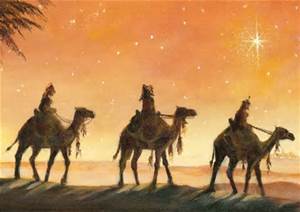
 OLD TESTAMENT: Isaiah 60: 1-6
Having just previously declared that God is coming as Redeemer, the writer of this part of Isaiah calls Israel to “Arise, Shine”. Essentially, it is a proclamation that God, the Eternal Light, has come. God’s Presence is already here and the transformation of the world has begun.
Now keep in mind that this was probably written at the end of the Babylonian exile. The once-thriving Jerusalem now sits empty, ravaged and desolate. The people lived in darkness and exile. The temple is gone, destroyed in the attack. And the dynasty of David, the veritable hope for the future, seemed to be at its floundering end. It would have been easy to miss seeing any good that might come of the situation, easy to miss any hint of things getting better. So this is the crescendo of the preparation for God’s arrival. Come on people, the prophet screams, Wake up! Don’t you see it? Things are happening! The days of waiting are over. Your children are being gathered even as we speak to return home. It is time now, time for Israel to become who God intended—a light to the nations.
Now, of course, it’s easy for us to sort of tack this passage on to our story of the Wise Men from the Gospel of Luke, but this really did not have anything to do with the exile. The Presence of God was palpable, moving into the desolation and beginning to re-create Jerusalem. It was time now to shape their life together as a people and as a community.
But for us, there is also that undercurrent of eschatological reflection. Our hereafter, our “heaven” as we know it, is not something out there or up there or just up ahead. It is not some “other” of “future” place to which we aspire to go. It is here. We just have to look around and see it. There are streams of souls in procession. We just have to find our place. And yet, even Israel didn’t understand the message any more than we do. God is not promising to make our lives easier, or to fill us with wealth and power, or to put us on top. God is promising to remake us, transform us into something completely different. God is promising not a return to normalcy but a new normal. In fact, if you read it, it’s a new normal for everyone—for all those camel drivers regardless of where they come from—Midian, Ephah, Sheba. In today’s terms, it’s all the camel drivers from somewhere in the Sudan, possibly modern-day Iraq, and probably Ethiopia, descending into the Holy Places not to go to war or to take people into exile but to come together, bringing their resources, and praising God as one.
This week we read three Scriptures that make up our Epiphany text. They are the same ones that we read every Epiphany. Perhaps we miss Epiphany. It sort of gets overshadowed by all the chaotic over-seasoning that came in the weeks before and the mad sprint toward Lent that is only weeks away. So we put on the green “ordinary” stoles and try to get our heads back above the ensuing waves. And yet, this is the place where it all comes together—the past promises that were made even as far back as the exile, that birth of the holy child that we just celebrated, and the rest—all of us that came after. The past now makes sense and the future becomes real. God’s Presence is always and forever in-breaking into this world. So, “Arise, Shine! For your light has come!” God is transforming all of us even as we speak.
- What is your response to this passage?
- Why is it so hard for all of us to gain a sense of God’s Presence in the darkness?
- What signs of the sacred and transformation do you see now?
- What stands in the way of your seeing that transformation?
- Do we lose something of the story if we read this solely as a prophetic recount of Christ rather than in the context in which it was written?
NEW TESTAMENT: Ephesians 3: 1-12
Read the passage from Ephesians
Paul and his disciples never used the word “Epiphany”. In fact, the day never really was mentioned until around the 4th century. And yet, whoever wrote this (probably not Paul), came really close to the whole notion that we celebrate: Something new has happened in Jesus. This was no ordinary baby. This was no ordinary mother. These were not ordinary shepherds and not your average run-of-the-mill Wise Men. They were all part of a new order, a new normal.
The writer acknowledges that this mystery of God’s Presence, the notion of the holy and the sacred actually being a part of us, was not made known to everyone. But now is the time. The Gentiles have been brought into the story, made characters in the ongoing story of God’s Incarnation. The point of the writing is to further explain what the readers of the letter have already gotten. They have already been gifted with this manifestation of Christ. They just had to open their eyes to know it. But this is not the “accepted” news and so the text implies that Paul’s relating of this mystery is the reason for his imprisonment (and, perhaps, you could surmise, the reason that one of Paul’s disciples may be writing this letter.)
But the writer does not seem to be discouraged. The Spirit has now made known what in former times was concealed, namely that the Gentiles are now fellow heirs, fellow members of the same body, and fellow participants in the promises. This idea of grace extended to all, even those seemingly unexpected recipients, is not really a new thing to Paul or to this writer. The assertion is that the mystery has been hidden with God, who is the creator of all things, suggesting that this mystery has always been God’s plan. This mystery in Christ — Lord over all peoples, both Jew and Gentiles — was the eternal plan of God, but only in the last days has God made it evident and begun its fulfillment.
The greatest celebration of the Incarnation is this celebration of the diversity and wisdom of the church brought together in unity, just as those Wise Men from the East (and Gentiles to boot), experienced the Presence of God. The greatest celebration of the Church is the coming together of all of this wisdom so that all in their own understanding might experience the Presence of God. The mystery is that this Holy Child, this Sacred Son of God, this Christ, this Messiah, is really intended to be Savior to us All.
- What meaning does this passage hold for you?
- How would this message be received by our society today?
- What does this new order mean for you?
- If diversity is the “new order” and the “mystery for the church, what does that mean in our modern culture?
- Do we really understand the concept of Jesus as “Savior to us All”?
GOSPEL: Matthew 2: 1-12
Read the passage from The Gospel According to Matthew
Our Gospel text this week begins by setting us “in the time of King Herod”. And in it, we find that the last question of Advent comes not at Christmas but afterward and is asked not by an individual but by a group. They believe that the star (or, for some, an unusual conjunction of heavenly bodies that produces an especially bright light) marks the birth of a special child destined to be a king. They ask, “Where is the child who has been born king of the Jews?
And so Herod hears that a king had been born in Bethlehem. Well, the formula is simple—a king is born, but a king is already here; and in Herod’s mind and the minds of all those who follow him, there is room for only one king. The passage says that King Herod was frightened and all Jerusalem with him. They probably were pretty fearful. After all, there was a distinct possibility that their world was about to change. It seemed that the birth of this humble child might have the ability to shake the very foundations of the earth and announce the fall of the mighty. Things would never be the same again.
So Herod relies on these wisest ones in his court. The writer of Matthew’s Gospel says that they’re from the East. Some traditions hold that these wise men were Magi, a Priestly caste of Persian origin that followed Zoroastrianism and practiced the interpretation of dreams and portents and astrology. Other traditions depict them with different ethnicities as the birth of this Messiah begins to move into the whole world. But somewhere along the way, they had heard of the birth of this king and came to the obvious place where he might be—in the royal household. So, sensing a rival, Herod sends these “wise ones” to find the new king so that he could “pay homage” to him. We of course know that this was deceitful. His intent was not to pay homage at all, but to destroy Jesus and stop what was about to happen to his empire. It was the only way that he could preserve what he had.
According to the passage, the wise men know that Christ was born; they needed God’s guidance, though, to find where Christ was. When they get to the place where the star has stopped, the passage tells us that they were “overwhelmed with joy”. They knelt down and paid the new king homage and offered him gifts fit for a king. Even though later interpreters have often tried to place specific meanings on these gifts of gold, frankincense, and myrrh, it is possible that the writer of the Gospel According to Matthew probably simply thought that these gifts, exotic and expensive as they were, were gifts that would be worthy of a great and mighty king. They were gifts of joy, gifts of gratitude, gifts of celebration.
And then the passage tells us that, heeding a warning in a dream, these wise and learned (and probably powerful) members of the court of Herod, left Bethlehem and returned to their own country, a long and difficult journey through the Middle Eastern desert. Rather than returning to their comfortable lives and their secure and powerful places in the court of Herod, they left and went a different way. They knew they had to go back to life. But it didn’t have to be the same.
So they slip away. Herod is furious. He has been duped. So he issues an order that all the children two years old and younger in and around Bethlehem should be killed. The truth is that Jesus comes into the world as it actually is, not as we wish it to be. Evil and greed are real and the ways of the world can and do crush life.
It is not really any different for us. After all, what has changed? Has Christmas produced for us some sort of “new normal”? There are too many places in the world where wars still rage. There are children that went to bed hungry last night and people in our own city that slept outside wrapped in anything that they could find hoping to stay warm. And, in the midst of it all, Congress is still arguing over the federal budget and Obamacare and whatever else that they can argue about and make themselves known to their constituents. What has changed? Well, not much. Truth be told, everything seems to have pretty much returned to normal.
But, then, think about that first Christmas. This passage moves the story beyond the quiet safety of the manger. We realize that the manger is actually placed in the midst of real life, with sometimes dark and foreboding forces and those who sometimes get it wrong. The primary characters are, of course, God and these visitors, these foreign Gentiles who did not even worship in the ways of the Jewish faith. They were powerful, intelligent, wealthy, and were accustomed to using their intellect and their logic to understand things. You know, they were a lot like us. But they found that the presence of the Divine in one’s life is not understood in the way that we understand a math equation. It is understood by becoming it.
Maybe that’s the point about Christmas that we’ve missed. Maybe it’s not just about the nativity scene. Maybe it’s more about what comes after. We often profess that Jesus came to change the world. But that really didn’t happen. Darkness still surrounded us. Does that mean that this whole Holy Birth was a failure, just some sort of pretty, romantic story in the midst of our sometimes chaotic life? Maybe Jesus didn’t intend to change the world at all; maybe Jesus, Emmanuel, God with Us, came into this world to change us. Maybe, then, there IS a new normal. It has to do with what we do after. It has to do with how we choose to go back to our lives. Do we just pick up where we left off? Or do we, like those wise men choose to go home by another way?
Many of us bemoan what seems to be a take-over of our Christmas by the culture and the society. We hear time and time again a calling to “put Christ back in Christmas”. Well, I don’t think that’s the problem. God in Christ has never left. We are not called to put Christ back in Christmas; we are called to put ourselves there. The story tells us that. The young Mary didn’t just come on the scene for a starlit evening. She was there, there at the cross. Her whole life became immersed in this child that she brought into the world. The shepherds stopped what they were doing, leaving their sheep on a hillside outside of Bethlehem with no protection from bandits or wild animals and thereby risking everything they knew, everything that would preserve their life the way it was. And those so-called Wisemen? They never went back. They chose to go home by another way.
And what about us? We are called to place ourselves in the story. We all have to go back. We all have to return to our lives. But that manger so long ago is not that far removed from us. In fact, it’s really sort of in the middle of our lives. God did not just visit our little earth so long ago and then return to wherever God lives. God came as Emmanuel, God with Us, and that has never changed. The birth of Jesus means that God was born in a specific person in a specific place. The Christmas story affirms to us that God is here, that the Messiah for whom we had waited has come, that we are in God’s hands. But the Epiphany story moves it beyond the manger. And all of a sudden we are part of the story. We are part of the Incarnation of God, the manifestation of God’s Presence here on our little earth. The God in whose hands we rest danced into our very lives and is now all over our hands. It is our move. God was not just born into the child Jesus; God is born into us, into humanity. And the world really hasn’t changed. But we have. And we are called to change the world.
- What meaning does this hold for you?
- What “other way” are we called to travel?
- What do you think of the notion that Jesus came to change not the world itself but us?
- What new light (pun intended) does Epiphany shed on the meaning of Christmas for you?
Some Quotes for Further Reflection:
The desire to find God and to see God and to love God is the one thing that matters. (Thomas Merton)
Get this first epiphany right–God perfectly hidden and perfectly revealed in the actual, and all the rest of the year will not surprise or disappoint you…If God can be manifest in a baby in a poor stable for the unwanted, then we better be ready for God just about anywhere and in anybody. The letting-go of any attempt to compartmentalize God will always feel dangerous and maybe even like dying…And it is both the ground and the goal of all mystical experience. Now God is in all things. We can no longer separate, exclude or avoid anybody or anything, especially under the guise of religion. We all, like the Magi, must now kneel and kiss the ground, throwing our own kingships to the wind…Afterwards, we are out of control, going back home by a different route, yet realigned correctly with what-is. Reality is still the best ally of God, and God always comes disguised as our life. (Excerpts from “Epiphany: You Can’t Go Home Again”, by Richard Rohr)
When the star in the sky is gone, When the Kings and Princes are home,
When the shepherds are back with their flocks, he Work of Christmas begins:
To find the lost,
To heal the broken,
To feed the hungry,
To release the prisoner,
To teach the nations,
To bring Christ to all,
To make music in the heart. (Dr. Howard Thurman, ‘The Work of Christmas”)
Closing
It is not over, this birthing. There are always newer skies into which God can throw stars. When we begin to think that we can predict the Advent of God, that we can box the Christ in a stable in Bethlehem, that’s just the time that God will be born in a place we can’t imagine and won’t believe. Those who wait for God watch with their hearts and not their eyes, listening, always listening for angel words.
(Ann Weems, Kneeling in Bethlehem (Philadelphia: Westminster Press, 1980), 85.)
 OLD TESTAMENT: Isaiah 7: 10-16
 JOURNEY TO PENUEL: Wrestling to See the Face of God