FIRST LESSON: Jeremiah 32: 1-3a, 6-15
To read the Lectionary Scripture text click here
The prophet Jeremiah has sort of changed his focus. These chapters are commonly called “The Book of Comfort”. It is 588 B.C. E., and Babylon is pounding on the door of Jerusalem – again. Ten years earlier, they had “disciplined” a rebellious Israel with a measure of destruction and had carried off some of its people. But now Israel was getting overly confident again, probably because they thought they had Egypt backing them up (sometimes it works to get one bully to fight the other), and the Babylonians were going to make it very clear that there would be no more trouble from this fledgling kingdom. We know that the destruction and exile that followed left a profound mark on the spirit and history of the people of Israel, when the land that had been promised to their ancestors long ago, the land to which their ancestors had been led through forty long years, the land that was, they thought, already theirs. Jeremiah had tried to warn them that they needed to get right with God instead of taking God’s favor for granted, and he saw Babylon as the instrument of God’s punishment for Israel’s unfaithfulness.
When Jeremiah hears that his relative, Hanamel, is going to come to him with the offer to sell him his land in Anathoth, and then Hanamel appears and does exactly that, Jeremiah knows that this “message from God” is valid. And so he obeys the command he has received, and purchases what is, at least at this moment, worthless land. (John Holbert calls it “the worst land deal in history.”) Now see, the people still remembered that the land was not only a gift from God, but in a very real way, still belonged to God. But what good was it when the Babylonians were squatting and camping on it? It certainly couldn’t be farmed, or provide sustenance or income for its owner. If he tried to sell it, he’d have to find another family member as “foolish” as he was, willing to pay money for what appeared to be worthless.
So, when the word of God came to Jeremiah and told him to buy the land, it also helped him to dare to see that there would be more than this impending desolation and that there would be life again, with God’s people back on their own land. That’s why Jeremiah ordered his secretary, Baruch, whom we meet for the first time here, to copy and preserve these documents of sale not only for verification but for future generations who will read them and be inspired to hope in their own day. Even though Jeremiah himself wouldn’t live to see this happen, he wanted to make sure that his descendants would see in the good times the hand of God fulfilling ancient promises, and would, in the bad times, hold fast to those same promises of abiding, faithful love and compassion by a generous but demanding God.
This is really a very forward-looking, faith-filled passage. It is a passage that dares to see that God holds more for us than what we imagine in our present circumstances. John Holbert says it like this:
Here is something that the prophet can teach those of us in the 21st century. When we see a world hell-bent on destruction, when we see the barbarians at the gate (of course, my barbarian may not be your barbarian!), when we think that the end has finally come to our hopes and dreams for justice and righteousness for all of God’s people, then we can watch the land deal of Jeremiah, watch him sign the deed, weigh out the money, give the deed and its copy to Baruch, witness Baruch put them in a jar, and we can know that the end has not yet come, because YHWH has more for us yet to do.
Baruch is Hebrew for “blessed”; that word is the first word of nearly every Jewish prayer. May it be the first word of our prayer, grateful for Jeremiah, grateful for his reminder to us that YHWH is not through with us yet. (From “The Worst Land Deal in History”, John C. Holbert, available at http://www.patheos.com/Progressive-Christian/Worst-Land-Deal-John-Holbert-09-23-2013.html, accessed 22 September, 2013)
1) What is your response to this passage?
2) What do you think of the idea of this “forward-looking” way of seeing things?
3) What stands in the way of our realizing that very notion?
4) What message does this hold for our own time?
NEW TESTAMENT: 1 Timothy 6: 6-19
To read the Lectionary Scripture text click here
This passage is countercultural – much more so for us than for its first hearers. Contentment rests in connectedness (rather than having everything that we want), above all, with God, because it connects us to others, to our world and to ourselves. The passage confronts our mortality. But it does so assuming we might worry about life beyond this one.
We are called to a lifestyle which makes do with enough. There is no need to busy oneself with more. Accumulation of wealth is the task of a lifetime and leaves little room for others and even for oneself (and frequently those around us usually when they need us most). So our passage is addressing the practicalities of living and identifying the deception which we forge when we spend our lives accumulating more and more – far more than we need. The author appears concerned primarily with self destructive forces which bring ruin. Greed for money also plunges others into poverty and ruin. The balance of the world begins to tilt.
“Godliness” was a popular value of that time (and our time, for that matter). But we need to be careful with this idea. We are NOT God. We are not even “God-like”. (And if we are, we need to look at ourselves a bit more!) Notions like righteousness, faith, and love carry much more value. They are essentially the alternative, the way of Christ. To decide for Christ is to decide against the prevailing cultural norms. We are reminded that Christ’s refusal to back away from his confession of this alternative, of God’s way was what hauled him before Pilate. The odds are overwhelming. It really is a struggle to resist the wealthy way of life which promises us contentment and takes away a living wage from others.
The author does not envision a belief that rebukes the rich. Rather, we are called to use our wealth effectively. Freed from the need to accumulate as the means of finding meaning in life, we can turn their attention beyond themselves to others and learn to love effectively with the means they have. The challenge is usually to know the cut off point of what is enough. Usually that inflates to levels of wealth which make the leftovers a symbol of excess rather than generous self giving. The problem is written across the face of the world. Its accepted violence evokes the abhorrent acts of terror which are then turned to justify our protecting our way of life. Christ offers a different way.
In a nutshell, the Way of Christ does not fit within the rules of the world. It’s hard to explain; it’s hard to understand; it just is. Frederick Buechner says this of “righteousness”:
“You haven’t got it right!” says the exasperated piano teacher. Junior is holding his hands the way he’s been told. His fingering is unexceptionable. He has memorized the piece perfectly. He has hit all the proper notes with deadly accuracy. But his heart’s not in it, only his fingers. What he’s playing is a sort of music but nothing that will start voices singing or feet tapping. He has succeeded in boring everybody to death including himself.
Jesus said to his disciples, “Unless your righteousness exceeds that of the scribes and Pharisees, you will never enter the kingdom of Heaven.” (Matthew 5:20) The scribes and Pharisees were playing it by the Book. They didn’t slip up on a single do or don’t. But they were getting it all wrong.
Righteousness is getting it all right. If you play it the way it’s supposed to be played, there shouldn’t be a still foot in the house. (from “Weekly Sermon Illustration: Righteousness”, by Frederick Buechner, available at http://frederickbuechner.com/content/weekly-sermon-illustration-righteousness, accessed 22 September, 2013.)
1) What does the term “godliness” mean to you?
2) How do you envision the “alternative” way of Christ?
3) So, what does this passage mean for us today?
4) What ways of life do we protect?
GOSPEL: Luke 16:19-31
To read the Lectionary Scripture text click here
This story apparently assumes that judgment takes place at the time of death. It seems to indicate a popular view of the afterlife among many Jews and non-Jews of the period which focused on the individual’s fate. In that sense it lacks the vision of a transformed world, which thought in wider than individual terms: the vision of a just society, transformed and recreated. So we probably need to supplement it with this wider and more inclusive vision. But it’s apparently set in the context of an abuse of wealth in that society.
The rich man is not depicted as one who is bad or evil; rather, his self preoccupation with which he prevented himself from caring about others as he cared for himself. The man is very rich and very privileged. In fact, wearing garments of purple suggests some link with royalty. Having a gate and a wall implies a large mansion. The poor man is named, Lazarus. The name means “God has helped”. The image is one of abject poverty and humiliation.
So, after each of their respective deaths, the rich man received the torment that he had dished out to others. And so, the rich man asks Abraham to get Lazarus to help him. What a reversal! Give him credit, the rich man then recovers some concern for others, but limited to his own family, his brothers (I hope he had no sisters!). The exchange which follows is interesting because it assumes that people need to hear the Law and the Prophets, whether from people still alive or from someone returned from the dead. The way to life is to keep the commandments in the way Jesus expounds them. Failure to heed this message on the assumption that faith in Jesus can be separated from it and will guarantee a place in heaven is as much a folly now as it was then. Being and doing are what matter, not signing up. It is not about earning a reward or racking up enough points, but about engaging in an ongoing relationship which has compassion as its agenda.
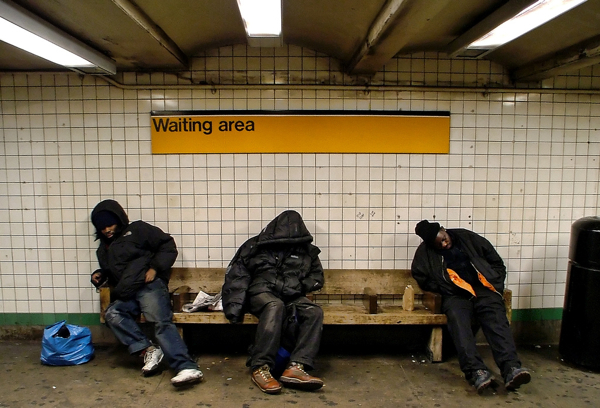
The parable obviously targets the violence of apathy and neglect which is widening the chasm between rich and poor. The trouble is that even such abstractions become easy to tolerate. We need some first hand experience of encountering the real people whom we will then not be able to dismiss as relative statistics. And if that cannot be first hand, we need to help people engage in active imagination of what it really means to be poor, to be a refugee, to be caught on the wrong side of the chasms which vested interests maintain.
This is not really meant as a literal portrait of what life after death is like. It reflects the Greek notion that souls go to the underworld for punishment at death. Hades is not mentioned anywhere else in the New Testament as a place of torment. In Jewish and Christian understanding the resurrection of the dead with judgment and vindication will happen when the Messiah returns, not on the immediate death of each individual. So we have here a parable meant to illuminate truths about the kingdom of God and shed light on how we are to live in this life, rather than the next.
Alyce McKenzie points out that “the background of this parable is a tale from Egyptian folklore about the reversal of fates after death. It also has connections to rabbinic stories. Rabbinic sources contain seven versions of this folktale. In Greek the name Lazaros has the same root consonants as the name Eliezer who, Genesis 15:2 tells us was a servant of Abraham. Some rabbinic tales feature Eliezer (Greek Lazaros) walking in disguise on the earth and reporting back to Abraham on how his children are observing the Torah’s prescriptions regarding the treatment of the widow, the orphan, and the poor. Lazarus is a poor beggar (16:20); he returns to Abraham’s bosom, and the rich man requests that Abraham send him as an emissary to his brothers.” (Alyce McKenzie, “To See or Not to See”, available at http://www.patheos.com/community/mainlineportal/2010/09/19/to-see-or-not-to-see-stepping-over-lazarus-reflections-on-luke-1519-26/.
This parable is found only in Luke. It underscores a theme expressed earlier in the Gospel (Luke 1:52). God has “put down the mighty from their thrones, and exalted those of low degree”. It also reflects Luke’s heart for the poor echoing his version (Luke 6:20) of Jesus’ earlier beatitude “Blessed are you who are poor (Matthew 5:3 has “poor in spirit”) because yours is the Kingdom of God.” The story is a three act play. The first act portrays the earthly contrast between the wealthy man and Lazarus. The second act describes the reversal of their conditions in the afterlife. The third act depicts the rich man’s request to Father Abraham for a sign so that those still living can avoid his torment, a request that Abraham refuses.
First century hearers of this parable would not have assumed that the rich man was evil and that the poor man was righteous. On the contrary, wealth in the ancient world was often viewed as a sign of divine favor, while poverty was viewed as evidence of sin. The rich man’s sin was not that he was rich, but that, during his earthly life, he did not even “see” Lazarus, despite his daily presence at the entrance to his home. It is interesting, however, that he knows his name. The rich man remains anonymous, but Lazarus has the distinction of being the only person given a name in any of Jesus’ parables.
The point is that we need a bigger transformation, a bigger vision than the tale actually depicts. It is a vision of a God who offers a place for all and turns no one away. And in order to be a part of this vision, we need to be able to see all of our brothers and sisters that share this kingdom with us. There are no longer divisions, no longer “the have’s” and “the have-nots”, no longer those who ignore the needs of someone else. Is that so hard?
1) What meaning does this passage hold for you?
2) What does this mean for us in our own society?
3) What situations does our society (and we) tolerate when we should be changing them?
4) What makes the difference between our seeing the Kingdom of God and not seeing it at all?
Some Quotes for Further Reflection:
We of the modern time live much more in the attitude of interrogation than of exclamation. We so blur our world with question marks that we lose the sense of wonder and sometimes even of vision. It is refreshing to note how frequently the great spiritual teachers of the New Testament introduce their message with the world “behold!” They speak because they see and they want their hearers and their readers to see. Their “behold” is more than an interjection—it has the force of an imperative, as though they would say: ‘Just see what I see. Open your eyes to the full meaning of what is before you, which is the method of all true teachers. (Rufus Jones)
To belong to a community is to begin to be about more than myself. (Joan Chittister, Listen With the Heart: Sacred Moments, in Everyday Life, 65)
Imagine a large circle and in the center of it rays of light that spread out to the circumference. The light in the center is God; each of us is a ray. The closer the rays are to the center, the closer the rays are to one another. The closer we live to God, the closer we are bound to our neighbor. (Fulton J. Sheen)
Closing
I am here in this solitude before you, and I am glad because you see me here. For, it is here, I think, that you want to see me and I am seen by you. My being here is a response you have asked of me, to something I have not clearly heard. But I have responded…You have called me here to be repeatedly born in the Spirit as your child. Repeatedly born in light, in unknowing, in faith, in awareness, in gratitude, in poverty, in presence, and in praise. Amen. (Thomas Merton)

 JOURNEY TO PENUEL: Wrestling to See the Face of God