 OLD TESTAMENT: Joshua 24: 1-3a, 14-25
To read the Old Testament Lectionary passage, click here
This is a familiar passage. It’s the stuff of which plaques all over gift stores are made. “As for me and my house, we shall serve the Lord.” Well, of course we will serve the Lord! Isn’t that what it’s all about? But, here, Joshua is pressing it a bit. Really? Is that really what you mean? Are you going to give up all this (with a broad sweep of his hand as he motions to all that is important). Well, of course. God is the god that we love; God is the god that we will worship. We have made our choice.
The problem is that with that choice, the hard part begins. You see, at this point, the Israelites were victors. We are no longer talking about exiled people trying to find their way back home. They had returned and had reclaimed their land from those who had been living there. The Book of Joshua refers to these now displaced people as the Amorites, which is not really a good indication of who they were. But, apparently, they were a people who worshipped other gods other than the one true YHWH. So, this notion of preaching to the victors, to those who were now a people of conquest rather than a people of exile brings about new questions and new meaning.
So, Joshua says, choose God. Choose THIS God, the God of your ancestors, the God of your conquests, the God who has brought you out on top, so to speak. God has fulfilled the promise to you. Now it’s your turn. What will be your response? No longer is this a God who is dragging you across the desert into the Promised Land. Instead, when your choice is THIS God, you have to change. You not only worship God; you follow God; you go toward God; you become who God envisions you to be.
If you read the passage, Joshua knows that their talk is shallow. They are promising obedience and devotion but it’s as if they have their fingers crossed behind them, as if they are still holding on to the gods that they have imagined just for good measure, these gods who offer beautiful and easy things, these gods who offer security and safety.
The people are asked to let go, to let go of the other gods. We are no different. What gods do we need to reject? What gods do we claim that are not the one true God? Under what authority do we place ourselves? You see, choosing God does not allow what Bonhoeffer would have talked “cheap grace”. The choice comes with a price. One is not just promising God one’s household; one is responding with one’s life. In other words, what do you do with that one precious life God has given you? Do you worship God and hold onto to other allegiances, to other gods, perhaps the god of comfort or the god of wealth or the god of career? Does God come before your need for security, before your need for recognition, or even, or even, your allegiance to your own household, to your own family? You see, this God of Israel, the one true God, was not requiring worship. Choosing God means that God gets it all, that your life, your breath, everything that is you responds to God’s call for justice, for mercy, for compassion. No longer is their room to hold back; no longer can you stock part of yourself away and give God what you can spare. Choosing God means choosing Life, a different Life, a Life that God envisions.
So Joshua made a covenant, a promise that day at Shechem. Joshua knows, and warns the people, that the choice will bring them trouble. The choice will bring about a reversal of sorts, will turn your world upside down. It’s a world of abundance—for every one. But you have to be willing to let go of that to which you hold onto so tightly.
He had real grit, that Joshua. When his fellow spies felt like grasshoppers and the Canaanites looked like giants, Joshua and his friend Caleb urged the Hebrews to take them on even when their compatriots threatened to stone them for their advice. After Moses died and Joshua assumed command, he showed his mettle by trusting God to bring down the walls of Jericho with only the sound of the trumpet and the shouts of the people.
But I think Joshua’s greatest moment came in his farewell speech to the Israelites, when he told them the truth about their covenant with God. He and his family had chosen to follow the Lord, Joshua proclaimed. The people roared enthusiastically. They would do the same. But Joshua didn’t accept their initial response. Instead he reminded them not once but three times of the cost of that covenant and the consequences of breaking it. If they dealt falsely with their God, Joshua warned, God would do them harm and consume them. Probably the Hebrews were ready to stone him for being so demandingly honest.
As a parish minister, I assume Joshua’s role when I invite people to affirm their covenant with God and one another. But I seldom have his courage in the follow-through. If I did, when parents brought their child for baptism, I would ask more than the generic “Do you promise to grow with this child in the Christian faith and offer him or her the nurture of the Christian church?”
Instead I’d ask, in front of God and the whole congregation, “Do you promise to get him or her out of bed, dressed and here every Sunday morning for the next 18 years, even when you’ve had a long week or you’d rather sleep in or there’s a soccer match or when this darling infant has grown into a surly, tatooed teenager who thinks church is ‘dumb’?”
I’ve never been that honest about baptismal vows. I bet Joshua would have been. When people join the church, Joshua would have asked more than a rote “Do you renounce the powers of evil and seek the freedom of new life in Christ?” After the unsuspecting new member said yes, Joshua would have followed with, “So when you buy your next car, will you resist all the commercial hype that encourages you to overspend on something that eats up resources and pollutes the air?”
Had Joshua presided at my ordination, I doubt he would have let me get by with a simple vow to study, pray, teach and preach. He probably would have demanded, “Will you give up your personal gods of procrastination, perfectionism and the pursuit of trivia?”
As a pastor, of course I’d like to beef up the traditional vows of baptism or membership. But then I’d need more assurance in dealing with Joshua’s dire consequences of covenant-breaking. For many people in my congregation, the primary experience of covenants — marriage, family, church affiliation or job — has been their endings. How do I capture Joshua’s passion for keeping covenant with God without sounding judgmental and damning of persons whose human covenants have been broken, either by design or default?…
I resonate with Joshua’s willingness to affirm what he believed, but I want to do it without damning other faiths. How do I retain the essence of his covenant without its exclusivity?
A chance encounter with Martin Marty taught me how. In 1989 Marty was speaking on religious pluralism at the University of New Mexico. I almost didn’t go — I’d had my fill of spiritual “options.” But I’d enjoyed his columns in the CENTURY for years, so I made the two-hour trip. What Marty said that night has been a plumb line for my ministry. When I asked, “What advice do you have for a United Church of Christ pastor serving a church that isn’t sure it wants to be a Christian church in the New Age capital of Santa Fe?” He paused. “The United Church of Christ?” he asked. I nodded. “You have the blood of the Puritans in you! Claim your inheritance.” But then he said, “If you go deep enough into any faith tradition, you find the common ground with all other traditions. That’s why a Baptist preacher like Martin Luther King could learn from Gandhi the Hindu, or why a Capuchin like Thomas Merton was in conversation with Buddhist monks.”
“I think that’s what all of us are seeking,” he continued. “We want that common ground. But we have to go deep into our own tradition to find it. You need to tell your people that.”
It’s been almost 15 years since that night, but there’s seldom a day I don’t remember Marty’s words. “Go deep,” he said. It sounds like Joshua’s “Choose this day whom you will serve.” Either way, it takes grit. Either way it leads to life and to God.
(From “True Grit”, by Talith Arnold, available at http://www.religion-online.org/showarticle.asp?title=2621
- What is your response to this passage?
- What are those gods that you need to reject in your life?
- What does grace cost you in your life?
- What, then, does it mean to serve God, to choose God?
NEW TESTAMENT: 1 Thessalonians 4: 13-18
To read the Lectionary Epistle text, click here
These words are probably written in response to deep and profound grief at the loss of one of the members of this fledgling new community of believers at Thessalonica. For us, it is a comfort. We have all experienced loss and grief. But this community has been a promise. Jesus was going to return. They believed that it would be soon and they worked toward that day. This wasn’t what they had planned. Surely Jesus was going to return before any of them were gone.
And so Paul offers them comfort and consolation. If you say you believe that Jesus was raised, that Jesus was resurrected, why can’t you believe in your own and that of those who have departed this life? Paul did not offer empty words of comfort. We’ve all heard things like “well, she’s in a better place now” or “God needed another angel in heaven” or “you know, we just can’t understand it right now” (I think that’s the one I usually use.) Grief is, at its best, hard to swallow.
We live in a world with a lot of “fixes”. We think we’re supposed to “fix” things and I would bet that pastors are some of the worst culprits. But Paul is not offering to “fix” death or even “fix” grief. Paul is exhorting his hearers to believe, to have faith, to know that God’s promise rings true, that Life will conquer death forever. But Paul’s words hold a reminder that it is not what we know now; it is not we think; it is not the way we imagine that things will be fixed. Imagining our own resurrection, our own rising to Life, means that we must die. We must die to this life little by little so that God can raise us up. It’s more than just comfort; it’s Truth. Our hope is in what we know to be true, not what we understand, not what we think will happen, but in what we know to be Truth. Our hope lies in what we take unto ourselves, that to which God calls us, and through which God will give us Life.
- What meaning does this passage hold for you?
- What does it mean to believe in our own resurrection?
- What gets in the way of us holding onto that Truth?
GOSPEL: Matthew 25: 1-13
To read the Lectionary Gospel passage, click here
First of all, it’s probably important to note that most interpreters would describe this as an allegory, rather than a parable. In other words, rather than something based on realistic details that weave together a point, this is a passage that is contrived to fit a particular and a somewhat abstract theological meaning. I mean, think about it, if it were to be taken at face value, where is the bride? The bride is never mentioned. You can’t have a wedding without a bride. And why are the shops open at midnight? This is not Las Vegas. And, in true Kingdom fashion, don’t you think the bridesmaids that had oil would have shared with the others? But the fact that some of the “literal” meanings don’t fit doesn’t diminish the importance that this passage holds for us.
Right at the beginning of it, Jesus tells us that five of the characters were foolish and five of them were wise. The reason he tells us this is because when we look at them, we can’t tell the difference. All ten have come to the wedding, their lamps aglow with expectation. All ten are dressed for what is to come. You see, it’s not their looks; it’s not how they act or dress or when they arrive. It is rather about readiness. For the writer of Matthew’s Gospel, “readiness” means living the life of the Kingdom throughout your life. It has nothing to do with making sure that your metaphorical lamp happens to be one of the ones lit when the Kingdom comes.
In the spirit of this allegory, which is found only in Matthew’s Gospel, the bridesmaids represent the future church, those who are ready to receive Christ into their lives. And the bridegroom for whom they are preparing is Christ in full glory as the Kingdom of God comes to be. And the oil with which the light is fueled is love, and compassion, and justice, and mercy—those things that are so much a part of what it means to live out the Gospel. But, as the passage indicates, a life of faith is not an easy one to sustain. Being a peacemaker, being merciful is easy for a day or two. It is deep into the night when one’s faith truly becomes that which sustains. Those who live lives of peacemaking and mercy-giving do so no matter what life brings them. They do it in the face of hardships and persecution as well as rewards. It is a much deeper meaning than merely “keeping awake”, as our interpretation suggests. If one truly lives a life of faith, it is not one of sleeplessness but, rather of living one’s life out with the confidence that one does abide in Christ. It means living a life ready to receive what Christ offers.
So what does that mean, to be “ready”? Contrary to what many do with this passage, it doesn’t mean to whip up expectations that a second coming is just around the corner so you can look busy. I mean, it’s been 2,000 years! It means just being who you are called to be and following the road down which God leads you. And, in the language of this allegory, it means keeping your lamp full enough that you can see where you’re going.
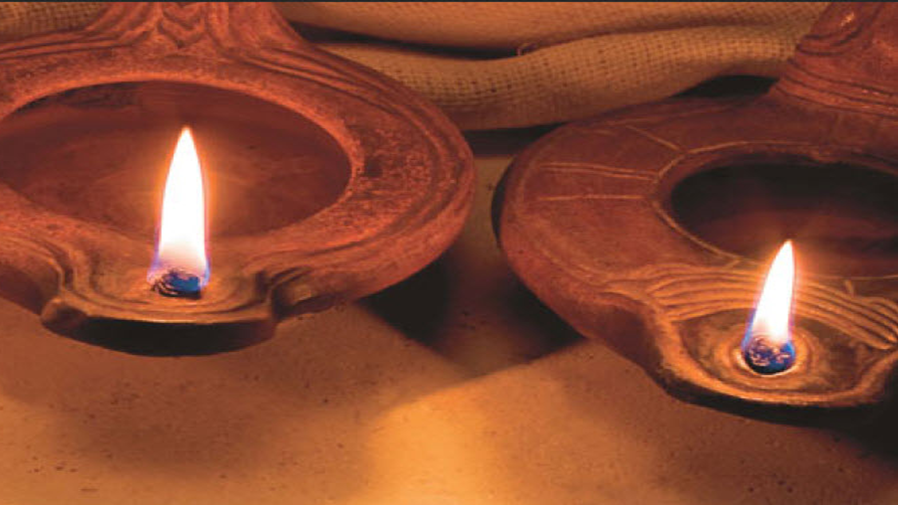
The oil, here, is not a commodity that we buy and sell, or even lend to each other, as we saw in the passage. There are some things that we have to do for ourselves. There are some reserves in our life that no one else can build for us. We have to figure out what it is that fills us up. What fills you up spiritually when you run dry? What replenishes your oil? Where in your life do you go to be with God? Because it is a fact that each of us from time to time runs dry. And when that happens, we can’t be a light for ourselves or anyone else.
You know, there’s a reason why flight attendants tell you that in the event that there is an emergency on an airplane and the oxygen masks drop from the ceiling, you are supposed to secure your own mask before assisting others. It’s essentially the same principal. Filling yourself up spiritually, indeed, filling yourself up with God, is not to guarantee you a place in heaven; it is to sustain you through this life until the Kingdom comes.
But we all know a simple law of physics. Before you can fill something up, you first have to empty it out. This is no different. Before one can fill their life with Kingdom things, fill their life with God, you have to get rid of those things that stand in the way. Looking back at the Scripture passage, there’s a piece of this that we risk missing because of our translation. Most modern English translations of this allegory have translated the Greek parthenoi as “girls” or, here, “bridesmaids”. But the literal translation of the word is probably more likely “virgins”. And, in case the significance of this is lost on us, Kathleen Norris’ depiction of the Virgin Mary can help. She points out that one who is virgin is one who is empty, open to receive and she says that from that standpoint, we are all called to be virgin, open to receiving God into our midst. To be a virgin is to have room. The Orthodox Christians call the Virgin Mary, “Theotokos”. We usually sort of loosely translate that as “Mother of God”. But the actual meaning of it is “God-bearer” or “one who gives birth to God”. And the only way to bear God, to give birth to God in your own life, is to empty yourself of other things. We are all called to be “God-bearers”. That is the oil that sustains us through this life and the next.
We are still looking toward that great wedding feast, the celebration of life at its fullest. And yet, it is possible even now for us to experience and glimpse what is to come. But, like Joshua told the people so long ago, we have to put away the foreign gods, we have to put away those things that we desperately hold onto that fill up that God-space in our lives and, like the Old Testament passage says, “incline our hearts to God.” We have to let go of the part of ourselves that we have created so that we will have room for the image of God that we were created to be.
In his book, The Sabbath, Abraham Heschel portrays the seventh day of Creation as a palace in time. He depicts it as God’s gift to us, a glimpse of a world to come, a glimpse of what it means to be God-filled. He says that “unless one learns how to relish the taste of the Sabbath, [the taste of the world to come], while still in this world,…one will be unable to [fully] enjoy the taste of eternity. Sad is the lot of [the ones] who arrive inexperienced and when led to heaven have no power to perceive [its] beauty.”[i]
You see, it’s not a question of who gets there and who doesn’t. It’s a question of how soon you get to see it and how prepared you are for the incredible beauty in its fullness. So, open yourself up and fill your life with God. And you will be ready to know the incredible things to come.
- What meaning does this passage hold for you?
- How would describe this “readiness”, this “awakeness”?
- What does it mean for you to be a God-bearer?
- Of what do you need, then, to empty your life in order to be ready to be filled?
Some Quotes for Further Reflection:
Faith isn’t faith until it’s all you’re holding onto. (Unknown)
The parts of the Christian story that had drawn me into the Church were not the believing parts but the beholding parts. (Barbara Brown Taylor)
The whole future of the Earth, as of religion, seems to me to depend on the awakening of our faith in the future. (Pierre Teilhard de Chardin)
Closing
Come, my Way, my Truth, my Life: such a way as gives us breath, such a truth as ends all strife, such a life as killeth death.
Come, my Light, my Feast, my Strength: such a light as shows a feast, such a feast as mends in length, such a strength as makes his guest.
Come, my Joy, my Love, my Heart: such a joy as none can move, such a love as none can part, such a heart as joys in love.
(George Herbert, 1633, “The United Methodist Hymnal”, # 164)
[i] Abraham Joshua Heschel, The Sabbath, (New York, NY: Farrar, Straus, and Girous, 1951), 74.

 JOURNEY TO PENUEL: Wrestling to See the Face of God