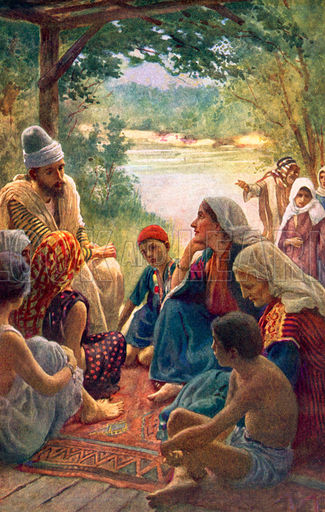
FIRST LESSON: Acts 16: 9-15
After Paul and his traveling companion Silas completed a tour of the churches that they had already founded on his first trip, they decided to strike out into new territory. But (as the verses immediately preceding this passage tell us), the Holy Spirit has “redirected” them, preventing them from going to Asia. So they instead traveled to Macedonia (i.e. Europe. So when you think about it, for those of us who are of European descent, this is our story.). We are told that Paul had a vision about a man from Macedonia pleading for Paul to come and help them. Now this was really a little odd when you think about it. They were setting sail for the seat of Western Culture—think Plato, Socrates, Aristotle, Alexander the Great, and Homer—that was the enlightened Western culture of the time. Paul was essentially taking the Christian message to the place from which the Westernized Greek culture had come three centuries before.
And there he encountered what was obviously an unlikely convert—a Gentile and a woman to boot! (What is really ironic is that European and Western Christianity struggled and continue to struggle for centuries over women in leadership and now we find out that the first European convert was a woman! Go figure!) Paul and Silas go looking for devout Jews to whom they could preach the Good News of Jesus Christ. They wait until the Sabbath, sure to find those that would be gathered in prayer. And, it seems, the ones he finds are women, praying not in a synagogue but near the river. Paul Walaskay points out that it is a bit of a surprise that the well-known Jewish Pharisee and teacher from Jerusalem would carry on a serious discussion with a group of women. (From Feasting on the Word) After all, this is flying in the face of what every good Jewish teacher knew and what every orthodox Jewish student was taught.
Lydia listens eagerly and embraces the message that Paul is bringing. She was baptized and then she continued to take an active role by inviting them to come and stay in her home. Without any hesitation at all, she opened her home in the name of Christ. Essentially, this unlikely convert in an unlikely place was one of Paul’s best disciples. That should be a lesson to all of us. What if Paul had been so sure of his original plan that he had insisted on not going to Macedonia at all? What if when he got there he had shunned the idea of ending up with a bunch of unimportant women not in the synagogue but outside the city gate? (In essence, Paul went to preach to the masses and ended up leading the UMW Circle or the Thursday Morning Lectionary Group!) But maybe Plan B didnn’t turn out so bad after all. Think of it. Think of all the cathedrals in Europe; think of the Vatican; think of Michelangelo and Da Vinci; think of the Sistine Chapel; think of Christianity as we know it today. This is where it begins. Visions and dreams are powerful things. We just have to listen to them. And sometimes they draw us beyond the boundaries that we’ve set around our lives.
The truth was that Lydia was ready for the Good News that Paul brought. She was longing for it, in fact. She did not let who she was or the boundaries that society had created for her stand in the way. We really know very little about her and, yet, she is a hero of the text. And the story almost didn’t happen. We don’t know who or what happened to the “man from Macedonia” that supposedly prompted this whole thing. In Feasting on the Word, Ronald Cole-Turner sums up this passage like this:
Here is the center of the story, the moment of intersection between human obedience and divine initiative. Longing and grace meet there on the bank of the river. The longing heart of a faithful woman is opened by the gracious impulse of a faith-giving God in an action that, like the incarnation itself, is at once fully human and fully divine. Like Lydia we are astonished when, looking back, we can say only that our steps were guided and our hearts opened.
1) What is your response to this passage?
2) In what ways are visions or dreams or other ways of discernment part of our faith journey?
3) Where do you find yourself in this story?
4) What stands in the way of our being open to the surprises that God offers to us in our lives?
NEW TESTAMENT: Revelation 21: 10, 22-22:5
This passage offers us yet another glimpse of how an early Christian hoped for the future. Drawing on Old Testament passages in Isaiah and Ezekiel, the author lays out a vision of the time when the throne of God will no longer be heaven, but rather heaven will be on earth. The writer’s vision of the in-breaking of the new comes set with a view from a high mountain. From it, he sees the “New Jerusalem” coming down from heaven and then goes into intricate detail of what that city looks like. In this vision, the city has no temple. Now remember that for centuries of Judaism and early Christianity, the temple was considered the dwelling place of God. But in this New Jerusalem, God has a new dwelling place—the city itself. It is the whole city, not just one place in it, that is the center of life, healing, and hope. It is symbolic for God’s activity and Presence in every corner of Creation, rather than in just those place that we’ve reserved for the Sacred and the Holy.
Revelation is itself an indictment of the domination and corrupting power of the Babylonian and Roman empires. In fact, it is an indictment of all empires that are not part of this vision of the Kingdom of God in its fullness. The key is that this indictment is against modern-day “empires” as much as it against what would have been 2nd century empires. In our modern-day thinking, empires have often become acceptable entities. We have become comfortable with decisions made for the good of a few, with things like preemptive war, and with a world where the successful and the powerful not only make the decisions but hold most of the world’s resources. How does that fit in with this vision of the “New Jerusalem”?
When most of us read this passage today, we imagine that city that it talks about. We imagine what it will be like someday to live in that city, to drink from that river of the water of life, and we try to live our lives in pursuit of it. Someday, we’ll leave all this behind and we’ll be with God. We’ll arrive in whatever place you envision our next thing to be. Someday, we’ll bask in light and life. Someday…But the truth is that there is not a city to pursue. There is not a river flowing in some far off place about which we only dream. We’ve already been given it. It is here…it is now. It is THIS city and THIS life that we are called to bring into that holy vision, to usher into eternity.
Methodist Bishop Peter Storey of South Africa is quoted by Joyce Hollyday in Feasting on the Word:
I have often suggested to American Christians that the only way to understand their mission is to ask what it might have meant to witness faithfully to Jesus in the heart of the Roman Empire…America’s preachers have a task more difficult, perhaps, than those faced by us under South Africa’s apartheid, or by Christians under Communism. We had obvious evils to engage…You have to expose and confront the great disconnect between the kindness, compassion, and caring of most American people and the ruthless way American power is experienced, directly and indirectly, by the poor of the earth. You have to help good people see how they have let their institutions do their sinning for them.
1) What meaning does this passage hold for you?
2) How do we envision that holy city about which the passage talks?
3) What stands in our way of bringing that about?
4) Why is it so hard for us to see this vision as a present reality?
5) What is your response or reaction to this claim by Peter Storey?
6) How do we respond to the notion of our institutions and the way we have “ordered” our existence essentially “sinning” on our behalf?
GOSPEL: John 14:23-29
This week’s Gospel passage raises new questions about our relationship with Jesus and our assumptions about God. Here, Jesus makes his absence imminent. We know that something is about to change. But he also leaves everything open for what is always an unfinished encounter with God. He promises the disciples that they will not be left alone, that a “Counselor”, an “Advocate”, the Holy Spirit will be there to help them remember what Jesus had always told them and teach them everything that they need to know. The writer of this Gospel does not abandon the traditional ideas of second comings and heaven but his emphasis is definitely on the here and now. In fact, upon Jesus’ departure from this earth, we are called to be the ones who serve as dwelling places for God in Christ’s Name. These are not images of dwelling places hidden away or secluded from the world, but in the midst of the world, in the midst of our very lives. We are essentially told to look less FOR the dwelling place of God and BECOME the dwelling place of God. In that is peace.
Faith does not take away all the difficulties of life—there is still grief and heartache, floods and hurricanes, oil spills, plant explosions, and terrorist plots. But this passage reminds us that we are not alone. God walks the journey with us, in us. Faith does not plug the holes in life making them all OK; faith rather enables you to keep your footing among them. Now note that Jesus does not say to wait until he returns; he tells the disciples to keep going, to keep moving, to keep being the people of God. And he tells them that they will have everything that they need—everything.
God is not something or someone that we need to pursue. Holiness is not something that we need to go toward. Everything is here. Everything is now. The passage tells us that God and Christ, that everything we’re wanting, that everything that we’re so desperately desiring, will make a home in our midst. We just have to get out of the way and let go of whatever it is we think we have to pursue. The Holy Spirit, the Advocate, the very essence of God in our midst brings it all into the present tense. Here…now…in this city, we are called to drink from the waters of life. We just have to stop the pursuit long enough to experience the Way, and the Truth, and the Life and realize that God has left a part of the Godself, the very essence of the holy and the sacred in our midst. Our calling is simply to welcome the Spirit in, to provide hospitality and space in our lives for that to happen, and to simply become the Breath of God that continually breathes Creation into being. But remember that it might come in the form of a Plan B.
1) What meaning does this passage hold for you?
2) What does it mean for you to think of the Holy Spirit as bringing God and the experience of God into the “present tense”?
3) Why is it that we feel we must “pursue” our relationship with God or our faith?
4) What would it mean to just love God and embrace the God that is with us now?
In garden design, gates and curved paths and alcoves satisfy a human desire for mystery and resolution. A well-planned garden mirrors the invitation to pilgrimage and spiritual completion. Ascensiontide — this most profound time of the Christian year — invites a man or woman of prayer to make a turn on the path that reveals that he or she has only been idling near the gate, and is only now beginning to explore the vast richness of the garden.
This Sunday finds the Christian world poised upon the edge of Ascension’s night of the soul. We hear the resurrected Jesus say to the disciples, “I am going away.” He has been with them 40 days. Jesus will take them once again to the Mount of Olives, that threshold between desert and city, sacred and profane, where the cloud of Divine Presence will absorb the risen Lord and leave his friends bereft once more.
The disciples have just gotten used to recognizing him again. He is teaching and breaking bread with them at Emmaus, appearing suddenly in the Upper Room, showing his wounds to Thomas, eating a fish. On the Sea of Galilee he calls out to the fisherman to “try the other side of the boat.” He cooks breakfast for them. Finally, after 40 days, they are getting used to his presence among them. And now he says, “I am going away.”
Could the extraordinary circumstances of resurrected encounter have lasted forever? Could these men and women have remained in that first union of intimate and personal friendship with the risen Lord? He tried to tell them, of course. “It is to your advantage that I go away, for if I do not go away, the Counselor will not come to you: but if I go, I will send him to you” (John 16:7). Winding through those last discourses in John is this message: You must go on. There’s more. You are not finished with your journey, you are not yet mature apostles. This is merely a resting place. I go to prepare another place for you. “I will come again and will take you to myself, that where I am you maybe also” (John 14:3).
Easter is not the end after all. Easter is not the final destination for the disciples, and not the final destination of the soul. Nor is Easter the final destination of the church. Easter begins the transition between one reality and another. The indwelling of the Holy Spirit cannot take place in that outer garden where Jesus has not yet ascended to the Father, where he has presence and voice, wounds open to the touch, where he is the risen Lord of a hot breakfast and a marvelous catch of fish. The disciples must once more taste emptiness and detachment, and open again the once-broken heart yet to be filled with the Holy Spirit. Only then will they go to “the ends of the earth.”
We know what’s going to happen. After Jesus is taken into the cloud the disciples go back to Jerusalem. Ten days later, while observing the Jewish feast of Pentecost, the Holy Spirit comes upon the company. And because we know what is going to happen, we tend to lose this crucial season of the soul — like decorating the house for Christmas and skipping Advent. I’ve actually heard Christian educators say, “There’s no point in having church school after Easter — we’ve come to the end of the church year, and besides everyone is so busy!”
When I was a little girl, the Paschal candle was extinguished in Ascension as a sign of the mystery of Christ’s departure. Basic to all prayer is the observance of cleansing purgation and ablution upon the threshold of fulfillment: Advent for the incarnation, Lent for the resurrection, Ascension for the Coming of the Holy Spirit. Ascension recognizes the separation of the Risen Lord from the disciples as he goes to dwell at the right hand of the Father. The cloud that takes him symbolizes the practice of a dark night of the soul. By practicing the seasons we know how to be in prayer. Why do modern Christians tend to dismiss Ascension? Is it part of our American denial of death? Is it fear and awe — the mysterium tremendum — of ascending in heart with Christ to the throne of God? Would we rather not accept the responsibility of apostleship at Pentecost and its radical implications?
St. Augustine urges, “Today our Lord Jesus Christ ascended into heaven — let our hearts ascend with him.” But we must also enter that cloud, that ancient euphemism for the unknowable Divine presence. The walk through Ascension may not be peaceful or beautiful or clear. But it is the way home. “Those who love me will keep my word, and my Father will love them, and we will come to them and make our home with them.” The indwelling of the spirit will become home.
“I saw no temple in the city, for its temple is the Lord God the Almighty and the Lamb. And the city has no need of sun or moon to shine upon it, for the glory of God is its light, and its lamp is the Lamb. By its light shall the nations walk; and the kings of the earth” (Rev. 21:22-24). The temple is the Lord God almighty dwelling within us. Our home will be wherever the Spirit sends us as apostles to the ends of the earth. But we don’t know all that yet. To find our way home we must go where Jesus has gone. We must take that surprising turn in the garden path. At the edge of Ascensiontide, we know only the threshold beyond which Jesus has gone, into a cloud of luminous darkness. (Suzanne Guthrie, “The Turn in the Path”, in The Christian Century, May 9, 2001, p. 13, available at http://www.religion-online.org/showarticle.asp?title=2125, accessed 5 May 2010.)
Some Quotes for Further Reflection:
The old divines talked about the gift of faith. It seems to me that there is an earlier gift, a desire, an openness to receive the light when and if it is offered. This openness is a quality of perception like poetry or divination or the wonderful imagination of a happy child. (Morris West)
He is the Way. Follow Him through the Land of Unlikeness; You will see rare beasts and have unique adventures.
He is the Truth. Seek Him in the Kingdom of Anxiety; You will come to a great city that has expected your return for years.
He is the Life. Love Him in the World of the Flesh; And at your marriage all its occasions shall dance for joy. (W. H. Auden)
Everything has already been given; what we need is to live into it. (Thomas Merton)
Closing
Come, my Way, my Truth, my Life: such a way as gives us breath, such a truth as ends all strife, such a life as killeth death.
Come, my Light, my Feast, my Strength: such a light as shows a feast, such a feast as mends in length, such a strength as makes his guest.
Come, my Joy, my Love, my Heart: such a joy as none can move, such a love as none can part, such a heart as joys in love. Amen.
(George Herbert, 1633, UMH # 164)

 JOURNEY TO PENUEL: Wrestling to See the Face of God