Pentecost B: Breathed Into

PentecostFIRST READING: Acts 2:1-21

To read the Lectionary passage from Acts, click here

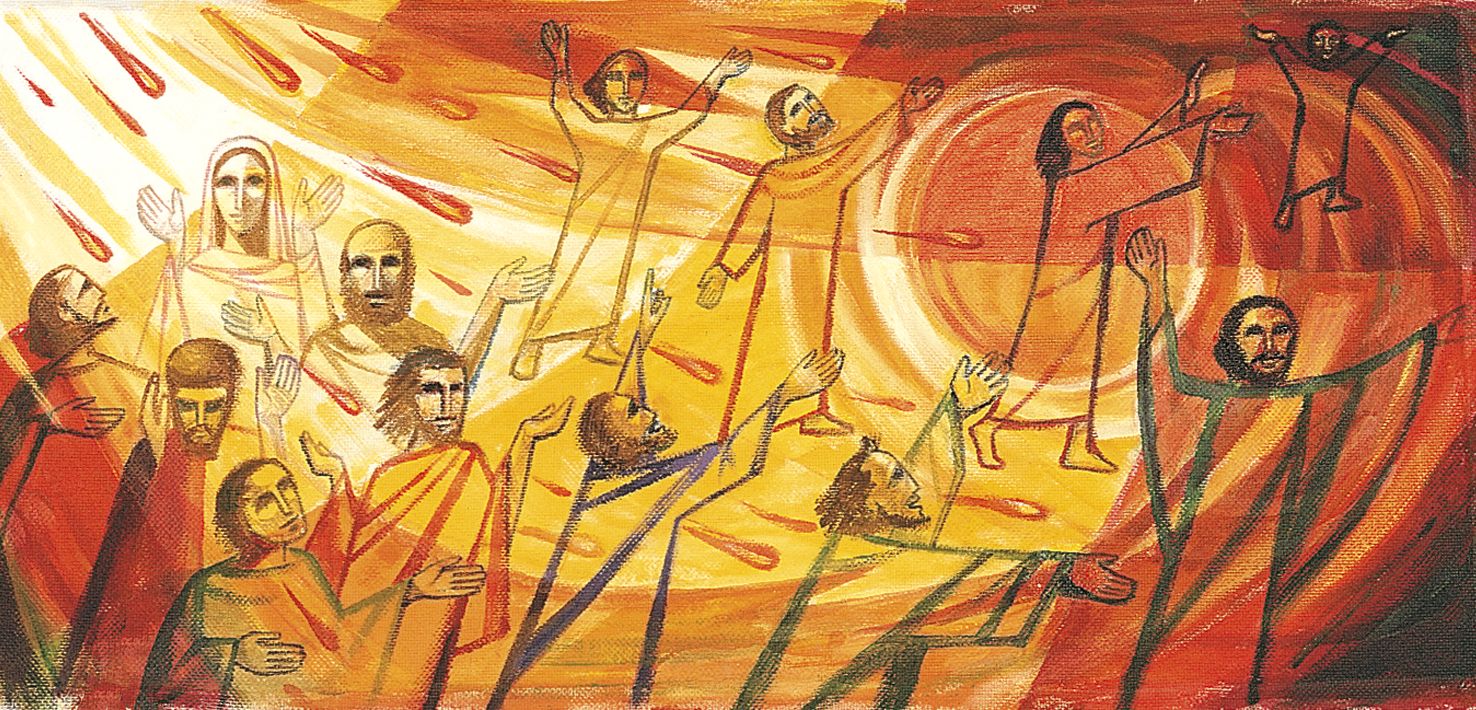
This passage completes the succession from Jesus to the disciples and is made complete with the arrival of God’s promised Spirit. This is the moment that had been predicted by both John the Baptist and Jesus and the passage is written to reflect that earlier prophecy. This passage has probably received more attention than any other in the Book of Acts. Certain faith traditions draw on it because of the experiential presence of faith and others use it to frame the season of Pentecost, when the church and its community are renewed and reborn by the power of God’s Spirit.

According to the passage, the entire community is baptized into the realm of the Spirit. The word for Pentecost (literally, “fiftieth day”) was used by Jews for a harvest festival more commonly known as the “Feast of Weeks”. The image of “tongues of fire” and the flames that are often used to symbolize Pentecost (as well as our own denomination) echoes the fire that was frequently used in Jewish and Greco-Roman writings as a metaphor for the experiences of prophetic inspiration.

The “gift of tongues” should not be confused with the spiritual gift of glossolalia that concerns Paul in 1 Corinthians 12-14. The Pauline meaning denotes a special language given to a few believers by the Spirit in order to edify the whole congregation. For the writer of Acts, though, this Spirit came upon all, rather than merely a chosen few. In many ways, the Pentecost experience of “tongues” has more to do with hearing and understanding than with speaking. It has to do with rhythm—that underlying rhythm that is part of us all, the rhythm that is God, our Source and Sustainer. So, the Pentecost story is about unity.

So God’s Spirit is poured out upon a community of believers. The Holy Spirit is not a “personal” gift from God. There is nothing personal or private (and certainly not restrictive) about it. The church has always tended to be comfortable with worshiping the Father and the Son but often the Holy Spirit is seen as a sort of marginal, misunderstood entity. But it is clear from this story that the arrival of the Holy Spirit is not hidden from view. The Spirit’s arrival is a noisy affair with special effects that draw an interested public “from every nation” to the community.

This arrival of the Spirit completes the picture—God created, redeemed, and is now empowering the people of God to be who God created them to be. This is the way that God sustains us in this world and the next. The Spirit does not imply a ghostly-type image. Talking about Spirit is talking about God. The Hebrew word for it is ruah–God in power like the force of wind or in intimacy like breath, the very essence and being of God. This is not speaking of bits and pieces of God. This is the fullness of God. This is God’s Kingdom coming. Pentecost is hope at its deepest level and the promise that everyone can be ignited by the Spirit in order to live out their God-called life. Nothing but fire kindles fire.

Pentecost did not create a church. This is not merely the church’s birthday. Pentecost is the point at which God’s very Spirit was breathed into the world and equipped us for work. Last week, we read of Christ’s Ascension, that holiest of absences that left a veritable void in the Gospel story. And so we waited. What Pentecost tells us is that we are the ones for which we’ve been waiting. It is not meant to be a feel-good, warm-fuzzy kind of day. The Holy Spirit is risky and sometimes painful, bringing about change and out and out revolution. The Holy Spirit invites failure rather than promises success, compels discomfort, rather than consolation. The Holy Spirit is not something that we just try on for size; it is tongues of fire that consumes us and leaves nothing behind except what was supposed to be in the first place—the ones for which we’ve been waiting.   In a 2007 commencement speech, Richard Lederer said “Let there be no distance between who you are and what you do.” That is our calling; that is what Pentecost is about—shrinking the distance between how we live and who we are called to be. So, get started…

Several years ago, I had an experience that, for me, gave life to this Pentecost story. I was traveling through Hungary as part of a church choir tour and one of our singing opportunities was the Sunday morning worship service of a small, extremely poor Protestant church on the Pest side of the city. No one in the small congregation spoke any English. We, of course, did not speak Hungarian either. You have to understand that the Hungarian language is usually grouped closely with Finnish because of its syntax, but it has so many words and sounds that are borrowed from Turkish as well as centuries of various gypsy languages that it has no real commonality with any language. So, our communication was limited to hand signals, nods, and smiles. The entire worship service was in this language that was more unfamiliar than anything that I had ever heard. We went through about an hour of unfamiliar songs, foreign liturgy, and a 30-minute sermon that meant absolutely nothing to us.

At one point I looked around and realized that they had their heads down and were speaking what must have been a common prayer. We put our heads down. As I sat there, praying my own prayer along with them, I was suddenly aware that something had changed. I still, of course, could not understand the words but somewhere in there I had heard something inherently familiar. I looked at the person next to me and said, “That’s the Lord’s Prayer.” I started with the second petition of the familiar prayer and slowly those around me began to join in. When we came to the end, there was sort of a stunned silence around us. We had all finished at the same time.

This was not a case of my somehow miraculously understanding a language that I did not know. It was, instead, a hearing of an incredible rhythm that runs beneath all language and connects us all. That rhythm is the Spirit of God. I realized at that moment that the point of the Biblical Pentecost story was not the speaking, but the hearing and the understanding.   Regardless of our differences, there is one common voice that connects us all, if we will only listen. (Shelli Williams)      

  1. What is your response to this passage?
  2. What is your image of the Pentecost experience?
  3. What lessons could we learn from the Pentecost experience?
  4. What is your response to the Lederer quote about the distance between who we are and what we do?


 NEW TESTAMENT: Romans 8: 22-27

To read the Lectionary Epistle passage, click here

This passage is a well-known depiction of God’s ongoing Creation. Like labor, both church and Creation long for the new life to arrive in its fullness. But it is not an “either / or” notion—Creation is ongoing, the coming of God’s Kingdom is both already and not yet. In fact, Creation is groaning through the birth of what it is to be even now. We understand that. Our own groans about what is wrong with the world, what is wrong with our country, what is wrong with the United Methodist Church are heard even now. What if we thought of those groans as the rumbling of the Holy Spirit as it is poured into our lives?

But God, as loving parent of all Creation, puts a mighty arm under the fractured Creation, not merely preserving it and protecting it, but setting it free to be. (This flies in the face of dualistic understandings of earth and heaven or mind and spirit. It does not speak of “rescuing” or even “saving from”, but adoption, redemption, freedom.) It is not God turning away from what is wrong with the world but picking it up and pulling it into being. In Feasting on the Word, Clayton J. Schmidt refers to Peter Storey’s notion of this “great nevertheless of God.” Schmidt says that “at first glance, [the world] seems full of angst: groaning and travail, unfulfilled longing, unseen hope, concerns too deep for words. But the hope here can be put in terms of what Peter Storey has called “the great nevertheless of God.” [Storey] developed this idea while serving as bishop of the Methodist Church in South Africa during the struggle against apartheid. Even while surrounded by the strong-armed agents of repression, Storey knew that the Holy Spirit was active in his nation. The government had all the power; nevertheless, God was with the poor in South Africa. The South African regime did not hesitate to use force in order to stop rebellion; nevertheless, Storey, along with Desmond Tutu and others, led the black South Africans in a peaceful revolution. The odds were heavily against the peaceful revolution; nevertheless, with God on their side, they were victorious. In the end, there was strong temptation to retaliate; nevertheless, God gave them a means of forgiving enemies and forming a reconciled nation. No matter what the odds, if God is in something, no obstacle can block the great nevertheless of God.”

Paul’s Letter to the Romans is considered his masterpiece. In it, he contends that all those who are indwelt with the Holy Spirit are shaped for that eternal glory that is already theirs in Christ. We are not alone. No matter how difficult life gets, we are supported by God’s Spirit. The Spirit teaches us and reaches for us even in our weakness. The phrase “we do not know what we ought to pray” is often used to support the notion of speaking in tongues, but it is more likely that Paul is just trying to make the point that life is difficult, full of limitations, and that no matter what, we remain secure in the Lord. Instead, God knows our mind, knows what we pray, knows what we need, if we are just open to what God provides us. Marjorie Thompson says of prayer, “Perhaps our real task in prayer is to attune ourselves to the conversation already going on deep in our hearts. Then we may align our conscious intentions with the desire of God being expressed at our core.”


  1. How does this passage speak to you?
  2. What images of Creation does this passage bring about?
  3. What does this say to you about prayer?
  4. What does this say to you about how we should look at the way the world is and our part in it?

GOSPEL: John 15: 26-27; 16: 4b-15

To read the Lectionary Gospel passage, click here

The word for “Spirit” here is “parakletos”, or paraclete. It has a range of meaning that includes advocate, encourager, comforter, helper. A paraclete was a patron or a sponsor that would speak and advocate on behalf of another. In other words, the Spirit, parakletos, advocates on behalf of Christ and on behalf of that for which Christ stood and taught and died. So the Spirit will enable the disciples to grasp what they had not gotten before, to grasp what Jesus was all about. The Spirit is a way of talking about God not as an other-worldly being, but as our companion. It is a redefining of truth.

Keep in mind that when Jesus returned, he did not find the disciples out doing what needed to be done. Instead, he found them huddled in a room, scared to death at the prospect of what might happen to them. So this is the promise that they are not alone, that God will see that they are equipped and empowered to do what needs to be done in the world. But it won’t happen unless Jesus leaves. Otherwise, they’ll just stay shut away from the world waiting for Jesus to show up and fix things.

But empowered by the Spirit, we are to make a case for Jesus in the world. Jesus is both fully absent and fully present. That is our mission—to become the hands and feet and voice and life of Christ in the world. It entails exposing sin as the killing of love, or God in Christ. It means exposing Jesus for the way Jesus was. Spirituality, then, is a way of advocating for God in the world, entering the advocacy and comforter that is God. God so loved the world. Human beings did not recognize that love. They killed it. God reaffirmed it. We can receive it, share it, and ourselves become advocates for that same love and life in the world, accompanied by the Holy Spirit. It’s not a matter of knowing everything to do; it’s a matter of knowing where to look for the strength that you need to be the change that you hope to see in the world.


  1. What meaning does this passage hold for you?
  2. What does the Holy Spirit mean for you?
  3. So what makes us uneasy about the concept of the Holy Spirit?
  4. What does it mean to you to talk about Jesus as both fully absent and fully present?
  5. What do you feel that you are empowered to advocate in the world?


“The celebration of Pentecost beckons us to keep breathing. It challenges us to keep ourselves open to the Spirit who seeks us. The Spirit that, in the beginning, brooded over the chaos and brought forth creation; the Spirit that drenched the community with fire and breath on the day of Pentecost: this same Spirit desires to dwell within us and among us.” (From Jan Richardson, The Painted Prayerbook, available at http://textweek.com/, (Pentecost A) accessed 7 May 2008.)


Some Quotes for Further Reflection:

God creates us, Jesus leads us, and the Holy Spirit shows us ways that are not always in the book. (Joan Chittister, In Search of Belief, p. 161)


Try, with God’s help, to perceive the connection—even physical and natural—which binds your labor with the building of the Kingdom of Heaven; try to realize that heaven itself smiles upon you and, through your works, draw you to itself; then, as you leave church for the noisy streets, you will remain with only one feeling, that of continuing to immerse yourself in God. (Pierre Teilhard de Chardin (1881-1955))


The Spirit of God is like our breath. God’s Spirit is more intimate to us than we are to ourselves. We might not often be aware of it, but without it we cannot live a “spiritual life.” It is the Holy Spirit of God who prays in us, who offers us the gifts of love, forgiveness, kindness, goodness, gentleness, peace, and joy. It is the Holy Spirit who offers us the life that death cannot destroy. Let us always pray: “Come, Holy Spirit, come.” (Henri J.M. Nouwen)


Closing


Spark of God, Spirit of Life! I remember and celebrate your dwelling within me.


Divine Fire, you never waver in your faithful presence. Amid the seasons of life, you are my inner illumination.


Ever-present Light, the spark of your inspiration has been with me in every moment of my life, always available to lead and guide me.


Eternal Joy, the dancing flames of your joy are reflected in my happiness and in the many ways that I delight in life.


Spirit of God, your fiery presence gives me passion for what is vital and deserving of my enthusiasm.


Blazing Love, the radiant glow of your compassion fills me with awareness, kindness, and understanding.


Purifying Flame, your refining fire transforms me as I experience life’s sorrow, pain, and discouragement.


Radiant Presence, your steady flame of unconditional love kindles my faithful and enduring relationships.


Luminous One, you breathed Love into me at my birthing and your love will be with me as I breathe my last. Thank you for being a shining Spark of Life within me. Amen.


(Joyce Rupp, in Out of the Ordinary: Prayers, Poems, and Reflections for Every Season, p. 199)

Christ the King A: Becoming the Body of Christ

Christ Pantocrator mosaic
Daphni, Greece (ca. 1080-1100)

OLD TESTAMENT:  Ezekiel 34: 11-16, 20-24

To read the Old Testament Lectionary passage, click here

The oracles of Ezekiel are often downright alarming to us.  The writer’s understanding of God often seems to us to depict a powerful and sometimes scary Holy One upon a high and mighty throne that judges and hands out punishment because of the sins of the people, so a little history would probably help us out a little.  First of all, the prophet Ezekiel was probably part of the group of those who were deported from Jerusalem to Babylon in the year 597 BCE.  So his ministry was to those who were in exile with him.  He used visions to give them hope, to remind them that God was present even in the exile with them.  But he also proclaimed that the loss of the temple and the exile was the people’s fault, rather than God’s, that the circumstances in which they now found themselves were consequences of what they had done and how they had acted.  They had heard God but had not taken God’s Word seriously.  He condemned the leaders for being irresponsible shepherds of the people and for their lack of justice toward those in their care.
So, this reading focuses on restoration.  Using the image of the shepherd, the writer depicts God as the One who will take over and rescue the sheep.  It depicts a Great Gathering.  God as the Shepherd seeks each one out and brings them to good pasture, green and lush and plenty.  The metaphor of the shepherd is a common one in the ancient Near East.  It is a metaphor not of passivity or weakness, but of a power defined by justice and compassion, which is why this reading works well for our Christ the King readings.  After the promise of new leadership, God promises a new covenant of peace.
If you read it, though, this is not necessarily an indictment but rather a condemning of the behavior of the unjust leaders (and possibly of the people themselves for following those who were not good and just!)  So God will step in.  In other words, hope is never lost.  We read the words “I will save my flock.”  There is talk of judgment, of justification, but over and above, God saves.  This is not carrying any of those so-called “hellfire and brimstone” images but rather the image of One who dispenses justice and discipline. This is not, contrary to what some would think, a God of wrath but, rather, a God of Righteousness, a God of Justice, a God of Light, lighting the way for those in darkness and shining a light on those who inflict the darkness.  But when it is all said and done, God will transform all into the flock of this righteous and just Shepherd, where they will be fed and nurtured, and live in peace.  It is the vision of the Peaceable Kingdom.  It is the vision of God.
We read this as part of our Christ the King Lection because it is a different view of the King.  The King is a Shepherd (and the Shepherd is a King).  This is not a King who rules in wrath and dispenses punishment but rather a King who rules in righteousness and dispenses justice.  And, more than that, this is a God who seeks and searches until the flock is found.  And when God starts dividing the flock, it’s not into “good and bad”, “right and wrong”, “us and them”.  Rather, it is bringing strength to the weak, healing to the injured, and “foundness” to the lost.  Any division that happens is so that God’s grace can permeate and save us all.
a.      What is your response to this passage?
b.      What is it about some of these visions that bother us so much?
c.       What image of the Peaceable Kingdom does this passage depict?
d.      Why do we insist on dividing God’s Kingdom into “us” and “them”?
NEW TESTAMENT:  Ephesians 1: 15-23
Most scholars agree that Ephesians is considered what you could call a “Deutero-Pauline” work, implying that it is “second” or “secondary”.  (This would also refer to 2 Thessalonians and Colossians).  These letters were probably written in the 70’s or 80’s.  Paul more than likely died around 60, sometime around Nero’s reign.  So, rather than being written by Paul himself, Ephesians was more than likely written by a follower of Paul, using the format and even the style that Paul employed in his letters.  This is not plagiarism.  In that society, placing someone else’s name on a work was considered the highest form of compliment.
The main purpose of Ephesians, probably written to a Gentile audience, seems to be to remind the believers of their communal identity in their new status in Christ and to urge them to walk in ways that demonstrate this communal identity and unity.  (When you think of it, this idea of “community” would probably have been more difficult for Gentiles to grasp than for the Jews of that time, who had a sense of community embedded in their very being.)  The church here is understood as a Body of Christ that is exalted, which resonates with our understanding of the community of saints here and forever.
In this week’s reading (which is actually made up of four run-on sentences for all you English writing aficionados!), the writer describes Christ’s Reign as having by established by God’s power in the work, death, Resurrection, and spirit of Christ.  It is not a matter of placing Christ as King over other Kings.  This is not some calculated hierarchy of authority.  Rather, Christ is King…Period.  There is no other.  And this Reign of Christ IS the fullness of the Kingdom of God, when peace and justice and righteousness will finally be securely in place.  Dietrich Bonhoeffer wrote that “nothing is lost…everything is taken up in Christ, rid of evil, and remade.  Christ restores all this as God originally intended to be—without the distortion resulting from our sins.”  (Dietrich Bonhoeffer, Letters and Papers from Prison, as quoted by Jennifer M. McBride in Feasting on the Word.)
In verse 18, “the riches of the glorious inheritance of the saints” refers to that inheritance that is extended through Christ who God raised from the dead, caused to sit in “heavenly places”, and gave authority over all things.  We are part of this inheritance.  But the reading does not end with the Kingship of Christ as one that is removed from us or one that is “out there” for us to inherit.  The reading instead closes with a reference to the church as the Body of Christ that is triumphant in all things, the point of eschatological fulfillment.  In other words, the Body of Christ is us.
There’s this huge poster way up on the wall of one of the meeting rooms at Lakeview, our Texas Conference assembly and retreat center.  If you look at it closely, you saw all these wonderful different pictures of people in ministry, doing what God called them to do.  But if you step back far enough, you realize that together the pictures form a silhouetted image of Jesus.  The point is that it takes all the pictures finally coming into being, coming into focus, and fitting with each other the way a jigsaw puzzle does, to realize that image of Christ, that Vision of God.
In this week when we celebrate the Reign of Christ, we are given a tiny glimpse of that vision that will be.  But unlike earthly kings and queens that we crown and just sit back to see what they do, the crowning of Christ as King comes one picture at a time.  What picture is yours?  What part of this vision has God called you by name to bring?  What were you created to be?
a.      What message does this reading hold for you?
b.      What image of the Reign of Christ does this reading give you?
c.       What does it mean for you to have this “inheritance”?
d.      So, what does it mean for us to BE the Body of Christ?
e.      What part of this vision is ours to build?
GOSPEL:  Matthew 25: 31-46
This passage probably makes all of us a little uncomfortable.  We’ve gotten to know this welcoming, nurturing Jesus and here, just before we read of the conspiracy to arrest Jesus in the next chapter, just before the beginning of the end, we get this.  First, we get a depiction of the Son of Man coming in all his glory.  It reflects the imagery of Daniel (7:13-14) and foretells the coming judgment.  The image seems to be a little scary.  From the throne, the King uses his authority to separate individuals like sheep and goats.  And we are told that the sheep will inherit the kingdom.  So what happens to the goats?
The issues of the final judgment and the establishment of God’s Reign were of paramount importance to the writer of Matthew’s version of the Gospel.  (So keep in mind that it’s not clear if these things were on the top of Jesus’ list!  In fact, there are some theologians that think that this prophetic writing was added to the end of the string of parables that came before it.)  I mean, think of all the ways that Jesus talked about salvation and the Kingdom.  None of them included a list of who was “in” and who was “out”.  Jesus seemed to be more concerned with showing everyone the way home.
The judgment is not based merely on doing the right thing.  In fact, both those who had done what was good and honorable and those who had not actually had the same response.  (When was that, Lord?)  That’s pretty cool.  Those who were doing the “right things” still had doubts, still had questions, still walked in faith.  But they loved their neighbor.  It was an authentic outpouring of the love of God.  Apparently, that’s what it’s all about.
But this is not a checklist of things to do so that you can go to heaven or whatever your vision of eternal life is.  This is depicting a way of living, a way of being.  This is depicting the Kingdom of God.  And getting signed on to the sheep team is not about us.  It is about loving our neighbor.  It is about being Christ in the world.  It is easy to read this and look upon salvation as something that we achieve.  But salvation is discovered (and sometimes in ways that we do not expect.)  And perhaps this writing is nothing more than a reminder of what it means to walk in the Way of Christ.  It means to love God and love neighbor.  The two cannot be separated.  As Christians (and as good Methodists), we usually default on the side of grace.  So, again, what happens to the goats?
I heard an NPR “Fresh Air” broadcast several years ago that included an interview with Mark Derr, a naturalist who recently wrote How the Dog Became the Dog—From Wolves to our Best Friends.  In his book, Derr explores how the relationship between humans and wolves developed, and how that relationship then influenced the physical evolution of wolves into dogs.  He says that he believes that humans and wolves developed a close relationship after recognizing themselves in each other while hunting.  So, he surmises, the dog is a creation of wolves and humans—of two equal beings that came together at a certain point in history and have been together ever since.  As time went on, the physical features of the wolf began to change.  It’s skeletal frame became smaller and its jaw shortened.  In essence, the wolf became a dog by becoming a little more like its human companions.  So, maybe we’re all a bunch of goats.  Maybe the point is to become a sheep by taking on more human characteristics, by following in the way of the one who was fully human and fully divine.
We stand in a threshold between two times.  The Kingdom of God has both already and not yet begun.  We are given glimpses of what will be, but there is still much work to be done.  In Creation, God gave the gift of the very essence of God.  God spoke Creation into being and called we humans to be the very image of the Godself, full of love and compassion and righteousness and a hunger for justice and peace.  In Feasting on the Word, Lindsay P. Armstrong depicts this passage as a “wellness check and possibly even a warning to those living in unhealthy, self-centered ways.”  He says that “we may not like warnings or wellness checks; after all, they ask us to recalibrate our lives.  However, they provide a critical wellness overview that we are wise to tend, particularly since heart trouble plagues us all.”
We do not do what we do as Christians to gain salvation.  Being Christian means loving God and loving neighbor.  It means being who God meant for you to be, the very image of the Godself, in the deepest part of your being.  It means becoming a sheep and realizing that it’s about more than you and all the other goats on your team.  It’s about the Shepherd; it’s about following Christ; it’s about being the Body of Christ in the world.
This week’s Gospel passage depicts what it means to live into the fullness of this glory—feeding where there is hunger, bringing water where there is thirst, providing clothing, and help, and companionship to those in need, and welcoming every stranger into our midst.  It is that ever widening circle bringing everyone into the center and it gives us that sacramental vision to which we are called—“when justice shall roll down like waters and righteous like an ever-flowing stream, when nation shall not lift up sword against nation, neither shall they learn war anymore.”  Rosabeth Kanter said that “a vision is not just a picture of what could be; it is an appeal to our better selves, a call to become something more.”  
a.      What meaning does this passage hold for you?
b.      What is so bothersome about this passage?
c.       How would we fare in our “wellness check”?
d.      What depiction does this provide for us of that Peaceable Kingdom?
Some Quotes for Further Reflection:
The marvelous vision of the peaceable Kingdom, in which all violence has been overcome and all men, women, and children live in loving unity with nature, calls for its realization in our day-to-day lives. Instead of being an escapist dream, it challenges us to anticipate what it promises. Every time we forgive our neighbor, every time we make a child smile, every time we show compassion to a suffering person, every time we arrange a bouquet of flowers, offer care to tame or wild animals, prevent pollution, create beauty in our homes and gardens, and work for peace and justice among peoples and nations we are making the vision come true. (Henri J.M. Nouwen, Bread for the Journey)
Jesus didn’t come to make us Christian; Jesus came to make us fully human. (Hans Rookmaaker)
The future enters into us in order to transform itself in us, long before it happens.  (Rainer Maria Rilke) 
Closing
To your table you bid us come.  You have set the places, you have poured the wine, and there is always room, you say, for one more.  And so we come. 
From the streets and from the alleys we come. 
From the deserts and from the hills we come. 
From the ravages of poverty and from the palaces of privilege we come. 
Running, limping, carried, we come. 
We are bloodied with our wars, we are wearied with our wounds, we carry our dead within us, and we reckon with their ghosts. 
We hold the seeds of healing, we dream of a new creation, we know the things that make for peace, and we struggle to give them wings. 
And yet, to your table, we come. 
Hungering for your bread, we come;
thirsting for your wine, we come;
singing your song in every language, speaking your name in every tongue, in conflict and in communion, in discord and in desire, we come.
O God of Wisdom, we come.  Amen.
                                                                        (Jan L. Richardson, In Wisdom’s Path, # 129)