Proper 12A: Beyond Mere Words

Mustard TreeOLD TESTAMENT:  Genesis 29: 15-28

To read the Old Testament Lectionary passage, click here

Leading up to this passage, Jacob meets Rachel first while she is shepherding her father’s flocks. He tells her and eventually her father who he is and who his mother is, identifying himself as Rebekah’s son but, interestingly, never as Isaac’s son. And he spends a month or so with them before the subject of marriage is mentioned. At some point during that month Jacob decides that he wants to marry Rachel, but the text tells us nothing about their relationship or her feelings about the matter. Rachel and Leah’s mother is missing from the story; it is not clear whether the authors and editors found her irrelevant or whether she was truly absent, either through death or some other circumstances.

Laban essentially invites Jacob to name his own “salary” as payment for working for Laban and receiving his daughter.  The seven years that Jacob must serve Laban seems excessive to us but was an acceptable dowry in this context.  It also shows how much Jacob truly loved Rachel.  Now, considering Jacob’s history, it was not surprising that Laban would be distrustful of him.  At the end of the seven years, Laban appeals to the normal tradition of marrying off the firstborn.  While this seems underhanded to us, perhaps it also points to Jacob’s deception in the matter.  Leah, we are told, has rakkuth eyes.  Although classic interpretations have depicted Leah as weak or ugly—“cow-eyed” is the classic interpretation—it could also mean “delicate” or “lovely”. So, from that standpoint, picture Rachel as the classic beauty and Leah as the sweet, tender one.  So, Jacob agrees to seven more years so that he could take Rachel as his second wife.

Even though we recognize that both Jacob and Laban were, in their own way, deceptive God’s plan is mediated through human activity and through Jacob’s service.  Interestingly enough, what this story DOESN’T deal with is how Leah and Rachel feel.  We are only told about Jacob and Laban.  In our view, Rachel and Leah are treated like property or chattel (and, sadly, that one was deemed to be more highly valued than the other).  But keep in mind that this was not written in the twenty-first century.  That was acceptable for the time.

For the first time here, most of us probably side with Jacob.  The trickster had finally been tricked.  The one who had deceived his blind father had himself been blinded to the truth.  Perhaps he had seven more years to think about his own life while he ached for the one that he really wanted.  But, regardless, once again, the promises that God has given are still delivered.  God still works even when we humans try to fulfill our own agendas and pad our own lives with more than we are due.  God still works, somehow eeking out the best of humanity and the best of God’s promise from even the worst that we offer.  And Jacob, it seems, is continuously being remade, always one rung at a time.  It all goes in to making this shallow, selfish, thoughtless young man into the Father of Israel.

When it was all said and done, both Rachel and Leah play a part in the Genesis history.  The two of them, along with their maids Bilhah and Zilpah would give birth to the Twelve Tribes of Israel.  (Leah would give birth to more than half of the children.)  Both were used to fulfill the promise of life that God had promised.  They would spend their lives together.  But in death, Rachel would be buried alone on the road to Bethlehem and Leah would be buried in the ancestral tomb with Sarah and Abraham, Rebekah and Isaac, and Jacob.

So, regardless of how we got there, the Abrahamic history continues…

 THE CHILDREN OF JACOB / THE TWELVE TRIBES


CHILD MOTHER DESCENDANTS NOTES
 

Reuben

   “see, a son!”


Leah

  Disqualified for sexual immorality with Bilhah (Gen. 35:22)
(1) Simeon

   “he who hears”


Leah

   
Levi

   “he will be joined”


Leah

Moses

Aaron

John the Baptist

The priestly Levites are not later included in the tribes.
(2) Judah

   “I will praise”


Leah

David monarchy

Jesse

Jesus Christ

(Probably the best-known of the tribes)
(3) Dan


Bilhah, Rachel’s handmaiden

Samson Conquered by the Assyrians and then were essentially lost in history.
(4) Naphtali


Bilhah, Rachel’s handmaiden

  Lost tribe.
(5) Gad


Zilpah, Leah’s handmaiden

  Lost tribe.
(6) Asher


Zilpah, Leah’s handmaiden

Anna, the prophetess Lost tribe.
(7) Issachar


Leah

  Traditionally dominated by religious scholars. (Symbiotic relationship with Zebulun Tribe)
(8) Zebulun


Leah

  Traditionally dominated by merchants. (Symbiotic relationship with Issachar Tribe)
Dinah


Leah

   
(9) Joseph


Rachel

  Jacob’s favorite son. His two sons were made into separate tribes of Israel.

The House of Joseph was the most dominant in the Kingdom of Israel.

(10) Benjamin


Rachel

Israel’s first King, Saul

The Apostle Paul

 
(11) Ephraim


(Son of Joseph)

  Younger son, but ranked higher (AGAIN!)
(12) Manasseh


(Son of Joseph)

   
  1. What is your response to this passage?
  2. What is most bothersome about this passage?
  3. Where do you see God’s presence in this story?
  4. This story is often touted as a “great love story”.  What do you think of that?  Where does Leah figure into this love story? 


NEW TESTAMENT:  Romans 8: 26-39

To read the Lectionary Epistle passage, click here

Here, Paul intends that the “groaning” of the church and the “groaning” of the world be seen as parallel.  The “weakness” that he talks about is essentially the fact that in this world, we are still subject to pain and despair, death and decay even as our souls are set for redemption.  The problem is that we don’t even realize what it is that we should be praying for.  In other words, we are so wrapped up in our life in this world that we don’t know what it is that we really want.  But Paul is claiming that through our weakness, the living Christ is revealed.  That is God’s ultimate purpose.  Paul depicts the process whereby God’s adopted children are shaped into a likeness of the image of Christ, God’s son.  The predestination language is referring to “those whom God foreknew”, implying all of us.  So, yes, we are “predestined” to become who God calls us to be.  Predestined is not meant to mean just some of us.

Within these verses are also a hint of Paul’s attempt to depict an “alternate existence”, above and beyond, and greater than, the Roman culture and empire that surrounded those to whom the letter was addressed.  Essentially, God is reshaping the world just as God is reshaping each human being in it.

The language toward the end of the passage is familiar to all of us.  Nothing will separate us from the love of God, no matter how awful things get.  But, it says, we are “more than conquerors”.  We are not called to wipe away all of those things on earth that we deem bad or evil or just not “up to snuff” based on what we have figured out is right. And we are not stoics sitting there taking the pain with no emotion and no involvement.  Rather, we know that God is walking us through everything, transforming it as we go.

From that standpoint, we, as Christians, are invited to live with God’s new creation on the horizon.  This great project, begun with the resurrection of Jesus, will continue until the whole world is transformed into what God envisions for it.  We are, then, called to live in an overlap of two creations—one old, one new, and to work for the new.  The vocation of the church is to, in essence, live within a “wrinkle” in time.  Our world is fraught with ambiguity.  We live in the midst of joy and pain, good and evil, life and death.  God is in the midst of it all.  Once again, Paul equates current suffering with God’s work. From that standpoint, Paul saw the suffering of Christians as redemptive.  God did not “pre-ordain” the suffering that happens.  Sadly, stuff just happens.  But God can still use it and transform it into life.  NOTHING will separate us from the love of God.

Maya Angelou, the great and prolific African-American poet, went back to her hometown in Stamps, Ark., with the television commentator Bill Moyers to meet with a group of children in the elementary school that Angelou had once attended. Maya Angelou looked into the eyes of those young children, and she said to them with honesty and with humility, “When I look at you, I see who I used to be. When you look at me, I hope you see the person that you can become.”(From “In God We Trust”, a sermon by Rev. Dr. George B. Wirth, available at http://day1.org/945-in_god_we_trust, accessed 18 July, 2011.)

Maybe this passage speaks more to us about hope than anything else.  Perhaps Paul was trying to help us learn to hope.  True hope is for what is beyond our control, for what is really beyond what we know.  Maybe it’s a calling to think bigger, to actually dare to hope that God will redeem even this messed up world in which we live.  Do you really believe that?  That’s what it’s all about. 

  1. What meaning does this passage hold for you?
  2. How easily do we accept that nothing, I mean NOTHING, separates us from the love of God?  What would our lives be like of we really, really believed that?
  3. What gets in the way of us believing that?
  4. For what do you hope?
  5. What do you think this, then, calls us to do? 


GOSPEL:  Matthew 13: 31-33, 44-52

To read the Lectionary Gospel passage, click here

The Parable of the Mustard Seed played upon an image that was popular for the time of a grand imperial tree image against the image of the lowly mustard seed and plant.  The mustard seed is an annual herb, whose small, almost microscopic, seeds, can produce a plant that is at the most six feet in height.  It is not a majestic tree.  From that standpoint, the “tree” image becomes inappropriate.  In its place is an ordinary plant from an ordinary seed.  It is a larger message than merely “from small things come great endings”.  Remember that mustard probably more closely resembles weeds.  So in Jewish law, you could not sow it just anywhere.  That would be against the laws of separateness and purity.  So why wouldn’t Jesus have used a noble cedar tree or the amazing olive tree that lives for centuries for the metaphor?  Why did Jesus use a then-little-used weed?  (And, after three weeks, I’m wondering what this obsession that Jesus had with weeds was all about!) The point is that God’s vision is not what we expect or what we’ve figured out that it should be.  It is not something that we can control (like weeds) and not something that we can determine where it will grow (like weeds).  Here, something ordinary becomes not just extraordinary but part of an alternative vision of the way things should be.  The ordinary (and the unwieldly!) becomes holy.

The Parable of the Yeast is also a play on the cultural “norm” of the day.  Yeast was often used as a symbol for corruption.  The yeast of the day is not in those little packets that make the bread smell so good as it rises.  Leaven was a molding, rotting lump of bread.  (Remember that “unleavened” implied purity.)  The focus of the parable is not merely the spread of Christendom throughout the world, but the surprising and unexpected spread of God’s Kingdom.

The Parable of the Hidden Treasure and the Pearl both focus on things of immense worth, perhaps things that you would find in the midst of something else.  It depicts finding something in an unexpected place, something that you hold more dear than anything else that you could possibly imagine.

The Parable of the Net is not merely a parable of evangelism—“fishing for people”—but of a sorting of things into their proper place upon the coming of the Kingdom of God.  It catches all (nets are not really very selective, if you think about it), but then needs some “sorting out”.  Now, I’m not convinced that this sorting into “good and evil” is really Jesus-like.  Many interpreters think that this section might have been added by later redactors that were a little over-zealous.  After all, remember from last week that it is not our job to lie in judgment.  Maybe this is more of a “sorting out” rather than a separation into “good” and “bad”.  After all, what if that which looks like disorder to us is actually in the midst of transformation?  Maybe the sorting has more to do with transformation than it does with exclusion.  That seems more “Jesus-like” to me.

Now understand that these are not full descriptions of the Kingdom of God.  Jesus was just trying to put it into some terms that we could understand.  The coming of the Kingdom of God is only understood through true discipleship.  I think that at their most basic, these parables are saying that we cannot DO anything to inherit the Kingdom.  It is not what is expected.  We just have to understand to whom we belong.  And we also have to remind ourselves that God is God and we are not, that our view of the way things should be may or may not be God’s vision of glory for which we hope.  Maybe Jesus was up to a little mischief here, trying to shake us up a bit, trying to shake some sense into us.  Maybe the message was to quit trying to fix it or figure it out and begin to live into it.

In “The Seeds of Heaven,” Barbara Brown Taylor writes movingly about the power of parables: “How can the language of earth capture the reality of heaven? How can words describe that which is beyond all words? How can human beings speak of God?” Perhaps we do best if we use the most ordinary things, as Jesus did, and “[trust] each other to make the connections…We cannot say what it is, exactly, but we can say what it is like, and most of us get the message…” And her most keen observation is about the “hiddenness” of the reign of heaven in these stories, all of them, and what that hiddenness may teach us about our own seeking: that in the most ordinary, everyday things and experiences are “signs of the kingdom of heaven, clues to all the holiness hidden in the dullness of our days…[it is possible] that God decided to hide the kingdom of heaven not in any of the extraordinary places that treasure hunters would be sure to check but in the last place that any of us would think to look, namely, in the ordinary circumstances of our everyday lives…” Where do you find the kingdom of heaven, and how do you experience it?

Alyce McKenzie says it like this:  A rule of thumb of parable interpretation is this: identify what is strange about the parable. It is your window into the kingdom of God. (Alyce McKenzie, “Strange Scripture”, available at http://www.patheos.com/Resources/Additional-Resources/Strange-Scripture-Reflections-on-the-Five-Parables-in-Matthew-13-Alyce-McKenzie-07-18-2011.html, accessed 18 July, 2011.) 


  1. What meaning does this passage hold for you?
  2. Which of these parables speaks to you and depicts what your image of God’s Kingdom is like?
  3. Are there any that are difficult for you?
  4. Where do you find the Kingdom of God and how do you experience it? 


Some Quotes for Further Reflection:

Human beings may separate things into as many piles as we wish—separating spirit from flesh, sacred from secular, church from world.  But we should not be surprised when God does not recognize the distinctions we make between the two.  Earth is so thick with divine possibility that it is a wonder we can walk anywhere without cracking our shins on altars. (Barbara Brown Taylor in An Altar in the World:  A Geography of Faith, p. 15.)


Your life is something opaque, not transparent, as long as you look at it in an ordinary human way.  But if you hold it up against the light of God’s goodness, it shines and turns transparent, radiant and bright.  And then you ask yourself in amazement:  Is this really my own life I see before me? (Albert Schweitzer)


The marvelous vision of the peaceable Kingdom, in which all violence has been overcome and all men, women, and children live in loving unity with nature, calls for its realization in our day-to-day lives. Instead of being an escapist dream, it challenges us to anticipate what it promises. Every time we forgive our neighbor, every time we make a child smile, every time we show compassion to a suffering person, every time we arrange a bouquet of flowers, offer care to tame or wild animals, prevent pollution, create beauty in our homes and gardens, and work for peace and justice among peoples and nations we are making the vision come true. (Henri J.M. Nouwen, Bread for the Journey) 


Closing

Be thou my vision, O Lord of my heart; naught be all else to me, save that thou art. Thou my best thought, by day or by night, waking or sleeping, thy presence my light.Be thou my wisdom, and thou my true word; I ever with thee and thou with me, Lord;Thou and thou only, first in my heart, great God of heaven, my treasure thou art.Great God of heaven, my victory won, may I reach heaven’s joys, O bright heaven’s Sun!Heart of my own heart, whatever befall, still be my vision, O Ruler of all. Amen.Ancient Irish words translated by Mary E. Byrne, 1905 (UMH # 451)
Proper 11A: Climbing to the Edge


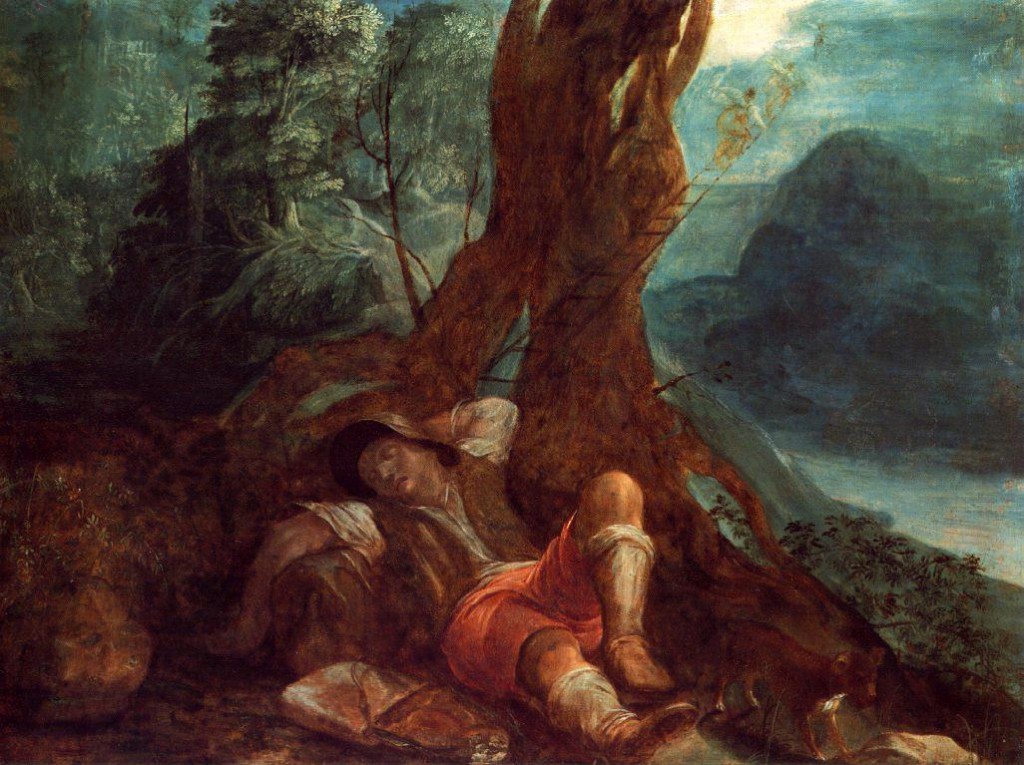
"Jacob's Dream", Adam Elsheimer, 1600
“Jacob’s Dream”, Adam Elsheimer, 1600

OLD TESTAMENT:  Genesis 28: 10-19a

To read the Old Testament Lectionary passage, click here

This Old Testament text stands as one of the pillars of the Jacob story.  God transmits to him the ancestral promises, fulfilling the promise made to his father.  This is the first time that Jacob appears by himself, representing a new beginning for the larger story as well as for Jacob himself. Jacob has fled from his troubled family and the wrath of his brother, Esau.  In a way, he is also running away from himself and his own consequences.  And at his most vulnerable, God appears to him, not in judgment, but to confirm Jacob as the one who is chosen to carry on the promise.  He dreams that a ladder, or more than likely a stairway or ramp, extends from earth to heaven.  The Hebrew word is sullam, which is from the same root as “to cast up”, and so a ramp or a stairway probably makes more sense.

This stairway or ramp could be compared with those attached to temple towers throughout the ancient Near East, such as the Mesopotamian ziggurats.  These were land masses formed into temples through which it was believed the earth could touch heaven, the dwelling place of the gods.  Such structures provided an avenue of approach from the human sphere to the divine realm.  Priests or divine beings traversed up and down the stairway, providing communication between the two realms.  What this said was that earth was not merely left to its own devices and that heaven is not a remote self-contained realm for the gods.  The two are intertwined, a part of one another.

But the importance here is not the presence of these divine beings—they serve only to depict the connection between the two realms.  More importantly, Yahweh, the Lord, stands beside Jacob and speaks directly to him.  Upon awakening, Jacob realizes the importance of his dream and he proceeds to interpret its significance.  He recognizes that he has some new idea of who God is.  Jacob takes God’s promises and claims them as part of who he is. He anoints the stone as a pillar, bringing sacredness to that which is holy.

A.W. Tozer said that “the patriarch Jacob…saw a vision of God and cried out in wonder, “Surely the Lord is in this place; and I knew it not.”  Jacob had never been for one small division of a moment outside the circle of that all-pervading Presence.  But he knew it not.  That was his trouble, and it is ours.  [Persons] do not know that God is here.  What a difference it would make if they knew.”

Some of the Jewish midrash suggests that the ladder is intended to represent humanity.  Like the ladder, each of us is firmly planted on earth.  But deep within us is the capability of “reaching upward” (figuratively), doing God’s will, and becoming the one that God created us to be.  This rhythm of ascent and descent, ascent and descent throughout our lives is what allows us to search ourselves and connect with God.

John Wesley made the claim, along the same vein, that Christ is the ladder, with a foot on earth in his human nature and the top in heaven just as Christ was divine.  “A ladder stood on the earth, and the top of it reached to heaven.”

It is not that Jacob had no sense of God.  After all, the idea of YHWH, the God of Creation and calling had been drilled into his family from even before his Grandfather Abraham.  God was a part of his life.  But Jacob’s theophany, the full revealing of God to him, had to occur outside and away from what he knew.  And, finally, Jacob embraced God not just as the God of Abraham, but the God of Jacob, the God who rather than having merely a general relationship with Creation, chooses to relate intimately to each and everyone of God’s children.  Jacob’s eyes are opened to a wider vision of God than he possibly could have imagined before.  It was not in this specific place that Jacob encountered God; it was, rather, here that Jacob realized that God had been there all along.  In fact, Jacob doesn’t even have to climb the ladder.  He encounters God without DOING anything.  It was here that he probably realized all that he’d been missing.  Maybe that’s the point.  Maybe there’s nothing that we have to DO except see what we’ve been missing all along. 

  1. What is your response to this passage?
  2. What image of God does this story create for you?
  3. What, like Tozer said, keeps us from realizing that all-pervading Presence that is God in our lives?
  4. If we all have the capability of “reaching upward”, as the midrash contends, what keeps us from doing that?
  5. When do we most realize that God has been there all along? 


NEW TESTAMENT:  Romans 8: 12-25

To read the Lectionary Epistle passage, click here

This section of the epistle to the Romans offers a celebratory declaration of present Christian existence, rooted in God’s past action in Jesus Christ, assured of God’s future action for Christ’s people and for the whole world, and sustained in the present by the Spirit.  It is essentially the conclusion of Paul’s argument for Christian assurance, for the belief that those whom God justified, God also glorified.

Put very simply, Paul is contrasting two ways of living—the way that we are tempted to live in this world and the way that God calls us to live.  He plays with notions of slavery and freedom—slavery to the perils of this world or freedom in God through Christ.  Slavery meant fear.  Slavery meant having no rights of inheritance, no birthright.  Slavery means no hope.  Freedom, then, means to belong to a family and to have the rights to an inheritance.  We have been adopted by Christ and will share in the inheritance that God provides.

When we believe in God, we realize that we are children of God.  But this also means that we suffer with Christ.  But this, too, is part of God’s promise of the renewal of all of Creation.  It is a hope that we cannot see on our own but are rather empowered to see through the Spirit of God.  Here, there’s more to being a Christian than just knowing the right stuff and doing the right things.  To be Christian, you must open yourself up and invite God’s Spirit to enter your life.  It is not enough to be “spiritual and not religious” no matter how in vogue it may be today.  Inviting God’s spirit to enter one’s life, becoming heirs of God’s Spirit, inheriting this Spirit of Pentecost, if you will, is the way that you will be glorified through Christ in God.  It’s that simple.

In an excerpt from a sermon entitled “Are You Saved”, Amy Miracle (how cool would that be to be Reverend Miracle?) says:

Frederick Buechner put it this way: “No matter who you are and what you’ve done, God wants you on his side. There is nothing you have to do or be. It’s on the house. It goes with the territory.”

That is the claim of scripture and the claim of the Christian tradition but we never seem to believe it. Surely there must be a catch, some book I need to read, some technique of prayer you need to master. There must be some minimum standard. How could salvation be available to absolutely everyone?

In her book, Pilgrim at Tinker Creek, Annie Dillard writes, “when I was six or seven years old … I used to take a precious penny of my own and hide it for someone else to find… For some reason I always “hid” the penny along the same stretch of sidewalk up the street…. Then I would take a piece of chalk and, starting at either end of the block, draw huge arrows leading up to the penny from both directions. After I learned to write I labeled the arrows: SURPRISE AHEAD or MONEY THIS WAY. I was greatly excited, during all this arrow drawing, at the thought of the first lucky passerby who would receive in this way, regardless of merit, a free gift from the universe.”

Salvation is like that. And the death and resurrection of Jesus is the arrow that points the way to this free gift. The very fact that salvation is free might be a problem. (From “Are You Saved?, by Rev. Amy Miracle, available at http://covenantnetwork.org/sermon&papers/miracle-04.html, accessed 11 July, 2011)

As the passage says, the “whole of Creation has been groaning in labor pains until now.”  Boy, you’re not kidding!  War, hunger, homelessness, elitism, sexism, racism…pick your “ism”…and an American Congress that thinks it’s more patriotic to insist on one’s own way than to do what would be best for most of the American people and a good part of the world.  But change can be painful.  That’s what Paul was trying to say.  We try to hold on to what we know, to what we can control, to what makes us comfortable.  But God has a different vision for us.  Change is hard.  But remember what happens when the pain subsides?  New life…You just have to let go of whatever it is that you are holding onto.  And be patient…when the time is right, it will happen.  When the time is right, we will finally realize that that for which we had hoped was there all along.

1)      What meaning does this passage hold for you?

2)      What does the “adoption” language mean to you?

3)      What images of God does this bring about for you?

4)      What image of salvation does that bring about for you?

5)      What vision of hope does this give you?

6)      What difficulty do we have with patience when it comes to our faith?


GOSPEL:  Matthew 13: 24-30, 36-43

To read the Lectionary Gospel passage, click here

The first parable in this reading is then followed by an allegorical interpretation of it in later verses.  Between these two sections are two other parables that we do not read as part of today’s lectionary.

The Parable of the Weeds probably comes from Matthew’s own experience within the church.  Essentially, it admits that the world, our family, and even our church is not always a trustworthy place.  When the master in the parable forbids the servants to go and weed out the field, this is not to be interpreted as a call to passivity in the face of evil.  It is not a divine command to ignore injustice in the world, violence in society, or wrong in the church.  It is a realistic reminder that the servants do not have the ability to get rid of all the weeds and that sometimes attempts to pluck up weeds cause more harm than good.  But the parable contains the promise that, in the wisdom of God, the weeds will ultimately be destroyed.  Evil is temporary.  The good endures.  The parable, so, leads to a place of joy and hope.

The word here for the “weeds” is the Greek, zizania, which refers to wild grasses, such as darnel or cockle, that closely resembled wheat—so close, in fact, that it was difficult to tell it apart from the fruitful wheat until it reached full maturity and just didn’t produce or act like wheat.

Keep in mind that the parables were not intended to be about the church or individuals but, rather about the Kingdom of God.  The parables speak of the final victory of the kingdom despite all appearances, and they challenge the church to respond to their message rather than find in them its guarantee of its own success.

Perhaps there were some sort of overzealous weeders in the writer Matthew’s community that prompted the inclusion of this parable.  And by trying to rid the community of the perceived “evil”, they were also destroying the good.  But we can’t help here but ask the usual question:  “Why does this all-good and all-gracious God allow evil to survive?”  Essentially, Jesus is saying, “don’t worry about it.”  It is not humanity that is chosen to discern and pluck away the evil from the good.  God will handle it; it is part of that vision that God holds.  After all, wasn’t God’s vision to redeem ALL of Creation?  And when we humans become over-zealous, how are we so sure that what we are “plucking” IS actually the weeds?  What if we are plucking good, honest, but not-yet-matured wheat?  (Which is why it is probably not meant to be up to us to discern what is “evil” and what is not.)

So instead of trying to figure out what’s wrong with the world and fixing it, our job is to get on with the mission that Jesus gave us—proclaiming that the Kingdom of God is coming into its fullness and all of Creation with it.  And, similar to the way we read last week’s parable, what if, rather than the wheat, we view our lives as the “field”.  We try to clean up our lives, to live as good, righteous people.  But, sure enough, those pesky weeds keep popping up unexpectedly.  Maybe the whole point is not to rid ourselves of the weeds, but to look to God when we get drowned out by them.  Maybe God is actually working on them to transform them into what they are supposed to be.

Here’s an excerpt from Richard Rohr, in the book, Everything Belongs: The Gift of Contemplative Prayer (p. 42, 51-52):


…When we avoid darkness, we avoid tension, spiritual creativity, and finally transformation.  We avoid God who works in the darkness—where we are not in control!  Maybe that is the secret…

Jesus pushes it back to the edge.  Can you even see the image of Christ in the least of the brothers and sisters?  He uses that as his only description of the final judgment.  Nothing about commandments, nothing about church attendance, nothing about papal infallibility:  simply a matter of our ability to see.  Can we see Christ in the least of the brothers and sisters?  Can we see Christ in the people, the nobodies who can’t play our game of success?  They smell.  They’re a nuisance.  They’re on welfare.  They are a drain on our tax money.  If we can, then we are really seeing.

He pushes it even further than that.  He says we have to love and recognize the divine image even in our enemies.  He teaches what they thought a religious leader could never demand of his followers:  love of the enemy.  Logically that makes no sense.  Soulfully it makes absolute sense, because in terms of the soul, it really is all or nothing.  Either we see the divine image in all created things or we don’t see it at all.  Once we see it, we’re trapped.  We see it once and the circle keeps moving out.  If we still try to exclude some:  sick people, blacks, people on welfare, gays (or whomever we’ve decided to hate), we’re not there.  We don’t understand.  If the world is a temple, then our enemies are sacred, too.  The ability to respect the outsider is probably the litmus test of true seeing.  It doesn’t even stop with human beings and enemies and the least of the brothers and sisters.  It moves to frogs and pansies and weeds.  Everything becomes enchanting.  One God, one world, one truth, one suffering, and one love.  All we can do is participate.  


  1. What meaning does this passage hold for you?
  2. Why is it so difficult for us to just let those things that we perceive as “evil” exist?  Why is it so difficult for us to accept that they exist at all in the midst of God’s Creation?
  3. How do you relate to the notion of your life being the “field”?
  4. What do you think of Rohr’s notion that everything becomes enchanting when we really see the way we’re supposed to see?


Some Quotes for Further Reflection:

To know that what is impenetrable to us really exists, manifesting itself as the highest wisdom and the most radiant beauty…this knowledge, this feeling, is at the center of true religiousness. (Albert Einstein, 1879-1955)


Tell us, Poet, what do you do?

I praise.  But the deadly and the monstrous things, how can you bear them?

I praise.  But what is nameless, what is anonymous, how can you call upon it?

I praise.  What right have you to be true in every disguise, behind every mask?

I praise.  How is it that the calm and the violent things like star and storm know you for their own?

Because I praise.  (Raine Maria Rilke, 1875-1926)


We must not try to reduce evil to good by seeking compensations or justifications for evil.  We must love God through the evil that occurs, solely because everything that actually occurs is real and behind all reality stands God.  Some realities are more or less transparent; others are completely opaque; but God is behind all of them, without distinction.  It is for us simply to keep our eyes turned toward the point where [God] is, whether we can see [God] or not. (Simone Weil, 1909-1943) 


Closing

For neither is there any god besides you,    whose care is for all people, For your strength is the source of righteousness,    and your sovereignty over all causes you to spare all. For you show your strength when people doubt    the completeness of your power,    and you rebuke any insolence among those who know it. Although you are sovereign in strength,    you judge with mildness,    and with great forbearance you govern us;    for you have power to act whenever you choose. Through such works you have taught your people    that the righteous must be kind,    and you have filled your children with good hope,    because you give repentance for sins.  Amen.

Wisdom of Solomon 12: 13, 16-19